The Bob Marley biography provides testament to the unparalleled influence of his artistry upon global culture. Since his passing on May 11, 1981, Bob Marley’s legend looms larger than ever, as evidenced by an ever-lengthening list of accomplishments attributable to his music, which identified oppressors and agitated for social change while simultaneously allowing listeners to forget their troubles and dance.
Bob Marley was posthumously inducted into the Rock and Roll Hall of Fame in 1994; in December 1999, his 1977 album “Exodus” was named Album of the Century by Time Magazine and his song “One Love” was designated Song of the Millennium by the BBC. Since its release in 1984, Marley’s “Legend” compilation has annually sold over 250,000 copies according to Nielsen Sound Scan, and it is only the 17th album to exceed sales of 10 million copies since SoundScan began its tabulations in 1991.
Bob Marley’s music was never recognized with a Grammy nomination but in 2001 he was bestowed The Grammy Lifetime Achievement Award, an honor given by the Recording Academy to “performers who during their lifetimes, have made creative contributions of outstanding artistic significance to the field of recording.” That same year, a feature length documentary about Bob Marley’s life, Rebel Music, directed by Jeremy Marre, was nominated for a Grammy for Best Long Form Music Video documentary. In 2001 Bob Marley was accorded the 2171st star on the Hollywood Walk of Fame by the Hollywood Historic Trust and the Hollywood Chamber of Commerce, in Hollywood, California. As a recipient of this distinction, Bob Marley joined musical legends including Carlos Santana, Stevie Wonder and The Temptations.
In 2006 an eight block stretch of Brooklyn’s bustling Church Avenue, which runs through the heart of that city’s Caribbean community, was renamed Bob Marley Boulevard, the result of a campaign initiated by New York City councilwoman Yvette D. Clarke. This year the popular TV show Late Night with Jimmy Fallon commemorated the 30th anniversary of Bob Marley’s passing with an entire week (May 9-13) devoted to his music, as performed by Bob’s eldest son Ziggy, Jennifer Hudson, Lauryn Hill, Lenny Kravitz and the show’s house band The Roots. These triumphs are all the more remarkable considering Bob Marley’s humble beginnings and numerous challenges he overcame attempting to gain a foothold in Jamaica’s chaotic music industry while skillfully navigating the politically partisan violence that abounded in Kingston throughout the 1970s.
One of the 20th century’s most charismatic and challenging performers, Bob Marley’s renown now transcends the role of reggae luminary: he is regarded as a cultural icon who implored his people to know their history “coming from the root of King David, through the line of Solomon,” as he sang on “Blackman Redemption”; Bob urged his listeners to check out the “Real Situation” and to rebel against the vampiric “Babylon System”. “Bob had a rebel type of approach, but his rebelliousness had a clearly defined purpose to it,” acknowledges Chris Blackwell, the founder of Island Records, who played a pivotal role in the Bob Marley biography by introducing Marley and the Wailers to an international audience. “It wasn’t just mindless rebelliousness, he was rebelling against the circumstances in which he and so many people found themselves.”
Joan of Arc, a peasant girl living in medieval France, believed that God had chosen her to lead France to victory in its long-running war with England. With no military training, Joan convinced the embattled crown prince Charles of Valois to allow her to lead a French army to the besieged city of Orléans, where it achieved a momentous victory over the English and their French allies, the Burgundians. After seeing the prince crowned King Charles VII, Joan was captured by Anglo-Burgundian forces, tried for witchcraft and heresy and burned at the stake in 1431, at the age of 19. By the time she was officially canonized in 1920, the Maid of Orléans (as she was known) had long been considered one of history’s greatest saints, and an enduring symbol of French unity and nationalism.
Joan of Arc’s Early Life
Born around 1412, Jeanne d’Arc (or in English, Joan of Arc) was the daughter of a tenant farmer, Jacques d’Arc, from the village of Domrémy, in northeastern France. She was not taught to read or write, but her pious mother instilled in her a deep love for the Catholic Church and its teachings. At the time, France had long been torn apart by a bitter conflict with England (later known as the Hundred Years’ War), in which England had gained the upper hand. A peace treaty in 1420 disinherited the French crown prince, Charles of Valois, amid accusations of his illegitimacy, and King Henry V was made ruler of both England and France. His son, Henry VI, succeeded him in 1422. Along with its French allies (led by Philip the Good, duke of Burgundy), England occupied much of northern France, and many in Joan’s village, Domrémy, were forced to abandon their homes under threat of invasion.
Did you know? In a private audience at his castle at Chinon, Joan of Arc won the future Charles VII over by supposedly revealing information that only a messenger from God could know; the details of this conversation are unknown.
At the age of 13, Joan began to hear voices, which she determined had been sent by God to give her a mission of overwhelming importance: to save France by expelling its enemies, and to install Charles as its rightful king. As part of this divine mission, Joan took a vow of chastity. At the age of 16, after her father attempted to arrange a marriage for her, she successfully convinced a local court that she should not be forced to accept the match.
Joan’s Journey to Orléans
In May 1428, Joan made her way Vaucouleurs, a nearby stronghold of those loyal to Charles. Initially rejected by the local magistrate, Robert de Baudricourt, she persisted, attracting a small band of followers who believed her claims to be the virgin who (according to a popular prophecy) was destined to save France. When Baudricort relented, Joan cropped her hair and dressed in men’s clothes to make the 11-day journey across enemy territory to Chinon, site of the crown prince’s palace.
Joan promised Charles she would see him crowned king at Reims, the traditional site of French royal investiture, and asked him to give her an army to lead to Orléans, then under siege from the English. Against the advice of most of his counselors and generals, Charles granted her request, and Joan set off for Orléans in March of 1429 dressed in white armor and riding a white horse. After sending off a defiant letter to the enemy, Joan led several French assaults against them, driving the Anglo-Burgundians from their bastion and forcing their retreat across the Loire River.
Downfall of Joan of Arc
After such a miraculous victory, Joan’s reputation spread far and wide among French forces. She and her followers escorted Charles across enemy territory to Reims, taking towns that resisted by force and enabling his coronation as King Charles VII in July 1429. Joan argued that the French should press their advantage with an attempt to retake Paris, but Charles wavered, even as his favorite at court, Georges de La Trémoille, warned him that Joan was becoming too powerful. The Anglo-Burgundians were able to fortify their positions in Paris, and turned back an attack led by Joan in September.
In the spring of 1430, the king ordered Joan to confront a Burgundian assault on Compiégne. In her effort to defend the town and its inhabitants, she was thrown from her horse, and was left outside the town’s gates as they closed. The Burgundians took her captive, and brought her amid much fanfare to the castle of Bouvreuil, occupied by the English commander at Rouen.
Joan of Arc: From Witch to Saint
In the trial that followed, Joan was ordered to answer to some 70 charges against her, including witchcraft, heresy and dressing like a man. The Anglo-Burgundians were aiming to get rid of the young leader as well as discredit Charles, who owed his coronation to her. In attempting to distance himself from an accused heretic and witch, the French king made no attempt to negotiate Joan’s release.
In May 1431, after a year in captivity and under threat of death, Joan relented and signed a confession denying that she had ever received divine guidance. Several days later, however, she defied orders by again donning men’s clothes, and authorities pronounced her death sentence. On the morning of May 30, at the age of 19, Joan was taken to the old market place of Rouen and burned at the stake. Her fame only increased after her death, however, and 20 years later a new trial ordered by Charles VII cleared her name. Long before Pope Benedict XV canonized her in 1920, Joan of Arc had attained mythic stature, inspiring numerous works of art and literature over the centuries and becoming the patron saint of France. In 1909 Joan of Arc was beatified in the famous Notre Dame cathedral in Paris by Pope Pius X. A statue inside the cathedral pays tribute to her legacy.
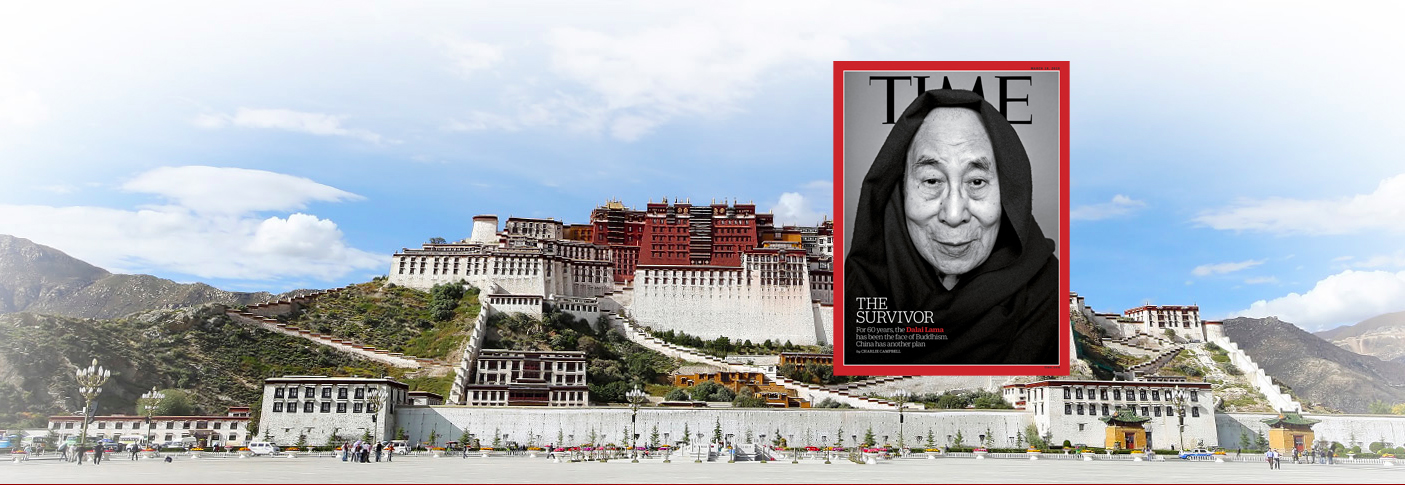
The Dalai Lamas are believed by Tibetan Buddhists to be manifestations of Avalokiteshvara or Chenrezig, the Bodhisattva of Compassion and the patron saint of Tibet. Bodhisattvas are realized beings, inspired by the wish to attain complete enlightenment, who have vowed to be reborn in the world to help all living beings.
His Holiness the 14th Dalai Lama, Tenzin Gyatso, describes himself as a simple Buddhist monk. He is the spiritual leader of Tibet. He was born on 6 July 1935, to a farming family, in a small hamlet located in Taktser, Amdo, northeastern Tibet. At the age of two, the child, then named Lhamo Dhondup, was recognized as the reincarnation of the previous 13th Dalai Lama, Thubten Gyatso.
The Dalai Lamas are believed to be manifestations of Avalokiteshvara or Chenrezig, the Bodhisattva of Compassion and the patron saint of Tibet. Bodhisattvas are realized beings inspired by a wish to attain Buddhahood for the benefit of all sentient beings, who have vowed to be reborn in the world to help humanity.
Education in Tibet His Holiness began his monastic education at the age of six. The curriculum, derived from the Nalanda tradition, consisted of five major and five minor subjects. The major subjects included logic, fine arts, Sanskrit grammar, and medicine, but the greatest emphasis was given to Buddhist philosophy which was further divided into a further five categories: Prajnaparamita, the perfection of wisdom; Madhyamika, the philosophy of the middle Way; Vinaya, the canon of monastic discipline; Abidharma, metaphysics; and Pramana, logic and epistemology. The five minor subjects included poetry, drama, astrology, composition and synonyms.
At 23, His Holiness sat for his final examination in Lhasa’s Jokhang Temple, during the annual Great Prayer Festival (Monlam Chenmo) in 1959. He passed with honors and was awarded the Geshe Lharampa degree, equivalent to the highest doctorate in Buddhist philosophy.
Leadership Responsibilities In 1950, after China’s invasion of Tibet, His Holiness was called upon to assume full political power. In 1954, he went to Beijing and met with Mao Zedong and other Chinese leaders, including Deng Xiaoping and Chou Enlai. Finally, in 1959, following the brutal suppression of the Tibetan national uprising in Lhasa by Chinese troops, His Holiness was forced to escape into exile. Since then he has been living in Dharamsala, northern India.
In exile, the Central Tibetan Administration led by His Holiness appealed to the United Nations to consider the question of Tibet. The General Assembly adopted three resolutions on Tibet in 1959, 1961 and 1965.
Democratization Process In 1963, His Holiness presented a draft democratic constitution for Tibet , followed by a number of reforms to democratize the Tibetan administration. The new democratic constitution was named “The Charter of Tibetans in Exile”. The charter enshrines freedom of speech, belief, assembly and movement. It also provides detailed guidelines on the functioning of the Tibetan Administration with respect to Tibetans living in exile.
In 1992, the Central Tibetan Administration published guidelines for the constitution of a future, free Tibet. It proposed that when Tibet becomes free the first task will be to set up an interim government whose immediate responsibility will be to elect a constitutional assembly to frame and adopt a democratic constitution for Tibet. His Holiness has made clear his hopes that a future Tibet, comprising the three traditional provinces of U-Tsang, Amdo and Kham, will be federal and democratic.
In May 1990, as a result of His Holiness’s reforms the Tibetan administration in exile was fully democratized. The Tibetan Cabinet (Kashag), which until then had been appointed by His Holiness, was dissolved along with the Tenth Assembly of the Tibetan People’s Deputies (the Tibetan parliament in exile). In the same year, exiled Tibetans living in India and more than 33 other countries elected 46 members to an expanded Eleventh Tibetan Assembly on a one-person one-vote basis. That Assembly then elected the members of a new cabinet.
In September 2001, in a further step towards democratization the Tibetan electorate directly elected the Kalon Tripa, the Chairman of the Cabinet. The Kalon Tripa appointed his own cabinet who then had to be approved by the Tibetan Assembly. This was the first time in Tibet’s long history, that the people had elected their political leaders. Since the direct election of the Kalon Tripa, the custom by which the Dalai Lamas, through the institution of the Ganden Phodrang, have held temporal as well as spiritual authority in Tibet, has come to an end. Since 2011, when he devolved his political authority to the elected leadership, His Holiness has described himself as retired.
Peace Initiatives On 21 September 1987 in an address to members of the United States Congress in Washington, DC, His Holiness proposed a Five-Point Peace Plan for Tibet as a first step towards a peaceful solution of the worsening situation in Tibet. The five points of the plan were as follows:
Transformation of the whole of Tibet into a zone of peace.
Abandonment of China’s population transfer policy that threatens the very existence of the Tibetans as a people.
Respect for the Tibetan people’s fundamental human rights and democratic freedoms.
Restoration and protection of Tibet’s natural environment and the abandonment of China’s use of Tibet for the production of nuclear weapons and dumping of nuclear waste.
Commencement of earnest negotiations on the future status of Tibet and of relations between the Tibetan and Chinese peoples.
On 15 June 1988, in an address to members of the European Parliament in Strasbourg, His Holiness further elaborated on the last point of the Five-Point Peace Plan. He proposed talks between the Chinese and Tibetans leading to a self-governing democratic political entity for all three provinces of Tibet. This entity would be in association with the People’s Republic of China and the Chinese Government would continue to be responsible for Tibet’s foreign policy and defence.
Universal Recognition is Holiness the Dalai Lama is a man of peace. In 1989 he was awarded the Nobel Peace Prize for his non-violent struggle for the liberation of Tibet. He has consistently advocated policies of non-violence, even in the face of extreme aggression. He also became the first Nobel Laureate to be recognized for his concern for global environmental problems.
His Holiness has travelled to more than 67 countries spanning 6 continents. He has received over 150 awards, honorary doctorates, prizes, etc., in recognition of his message of peace, non-violence, inter-religious understanding, universal responsibility and compassion. He has also authored or co-authored more than 110 books.
His Holiness has held discussions with heads of different religions and participated in many events promoting inter-religious harmony and understanding.
Since the mid-1980s, His Holiness has engaged in a dialogue with modern scientists, mainly in the fields of psychology, neurobiology, quantum physics and cosmology. This has led to a historic collaboration between Buddhist monks and world-renowned scientists in trying to help individuals achieve peace of mind. It has also resulted in the addition of modern science to the traditional curriculum of Tibetan monastic institutions re-established in exile..
Political Retirement On 14 March 2011 His Holiness wrote to the Assembly of Tibetan People’s Deputies (Tibetan Parliament-in-exile) requesting it to relieve him of his temporal authority, since according to the Charter of the Tibetans in Exile, he was technically still the head of state. He announced that he was ending the custom by which the Dalai Lamas had wielded spiritual and political authority in Tibet. He intended, he made clear, to resume the status of the first four Dalai Lamas in concerning himself only with spiritual affairs. He confirmed that the democratically elected leadership would assume complete formal responsibility for Tibetan political affairs. The formal office and household of the Dalai Lamas, the Gaden Phodrang, would henceforth only fulfil that function.
On 29 May 2011 His Holiness signed the document formally transferring his temporal authority to the democratically elected leader. In so doing he formally put an end to the 368-year old tradition of the Dalai Lamas functioning as both the spiritual and temporal head of Tibet.
The Future As far back as 1969, His Holiness made clear that whether or not a reincarnation of the Dalai Lama should be recognised was a decision for the Tibetan people, the Mongolians and people of the Himalayan regions to make. However, in the absence of clear guidelines, there was a clear risk that, should the concerned public express a strong wish to recognise a future Dalai Lama, vested interests could exploit the situation for political ends. Therefore, on 24 September 2011, clear guidelines for the recognition of the next Dalai Lama were published, leaving no room for doubt or deception.
His Holiness has declared that when he is about ninety years old he will consult leading Lamas of Tibet’s Buddhist traditions, the Tibetan public, and other concerned people with an interest in Tibetan Buddhism, and assess whether the institution of the Dalai Lama should continue after him. His statement also explored the different ways in which the recognition of a successor could be done. If it is decided that a Fifteenth Dalai Lama should be recognized, responsibility for doing so will rest primarily on the concerned officers of the Dalai Lama’s Gaden Phodrang Trust. They should consult the various heads of the Tibetan Buddhist traditions and the reliable oath-bound Dharma Protectors who are linked inseparably to the lineage of the Dalai Lamas. They should seek advice and direction from these concerned parties and carry out the procedures of search and recognition in accordance with their instruction. His Holiness has stated that he will leave clear written instructions about this. He further warned that apart from a reincarnation recognized through such legitimate methods, no recognition or acceptance should be given to a candidate chosen for political ends by anyone, including agents of the People’s Republic of China.
Steven Paul Jobs was an American inventor, designer and entrepreneur who was the co-founder, chief executive and chairman of Apple Computer. Apple’s revolutionary products, which include the iPod, iPhone and iPad, are now seen as dictating the evolution of modern technology. Born in 1955 to two University of Wisconsin graduate students who gave him up for adoption, Jobs was smart but directionless, dropping out of college and experimenting with different pursuits before co-founding Apple with Steve Wozniak in 1976. Jobs left the company in 1985, launching Pixar Animation Studios, then returned to Apple more than a decade later. Jobs died in 2011 following a long battle with pancreatic cancer.
Young Steve Jobs
Joanne Schieble (later Joanne Simpson) and Abdulfattah “John” Jandali, two University of Wisconsin graduate students, gave up their unnamed son, Steve Jobs, for adoption. Jobs’ father, Jandali, was a Syrian political science professor, and his mother, Schieble, worked as a speech therapist. Shortly after Steve was placed for adoption, his biological parents married and had another child, Mona Simpson. It was not until Jobs was 27 that he was able to uncover information on his biological parents.
As an infant, Jobs was adopted by Clara and Paul Jobs and named Steven Paul Jobs. Clara worked as an accountant and Paul was a Coast Guard veteran and machinist. The family lived in Mountain View, California, within the area that would later become known as Silicon Valley. As a boy, Jobs and his father worked on electronics in the family garage. Paul showed his son how to take apart and reconstruct electronics, a hobby that instilled confidence, tenacity and mechanical prowess in young Jobs.
Education
While Jobs was always an intelligent and innovative thinker, his youth was riddled with frustrations over formal schooling. Jobs was a prankster in elementary school due to boredom, and his fourth-grade teacher needed to bribe him to study. Jobs tested so well, however, that administrators wanted to skip him ahead to high school — a proposal that his parents declined.
After high school, Jobs enrolled at Reed College in Portland, Oregon. Lacking direction, he dropped out of college after six months and spent the next 18 months dropping in on creative classes at the school. Jobs later recounted how one course in calligraphy developed his love of typography.
In 1974, Jobs took a position as a video game designer with Atari. Several months later he left the company to find spiritual enlightenment in India, traveling further and experimenting with psychedelic drugs.
Apple Computer
In 1976, when Jobs was just 21, he and Steve Wozniak started Apple Computer in the Jobs’ family garage. They funded their entrepreneurial venture by Jobs selling his Volkswagen bus and Wozniak selling his beloved scientific calculator. Jobs and Wozniak are credited with revolutionizing the computer industry with Apple by democratizing the technology and making machines smaller, cheaper, intuitive and accessible to everyday consumers.
Wozniak conceived of a series of user-friendly personal computers, and — with Jobs in charge of marketing — Apple initially marketed the computers for $666.66 each. The Apple I earned the corporation around $774,000. Three years after the release of Apple’s second model, the Apple II, the company’s sales increased by 700 percent to $139 million.
In 1980, Apple Computer became a publicly traded company, with a market value of $1.2 billion by the end of its very first day of trading. Jobs looked to marketing expert John Sculley of Pepsi-Cola to take over the role of CEO for Apple.
The next several products from Apple suffered significant design flaws, however, resulting in recalls and consumer disappointment. IBM suddenly surpassed Apple in sales, and Apple had to compete with an IBM/PC-dominated business world.
In 1984, Apple released the Macintosh, marketing the computer as a piece of a counterculture lifestyle: romantic, youthful, creative. But despite positive sales and performance superior to IBM’s PCs, the Macintosh was still not IBM-compatible. Sculley believed Jobs was hurting Apple, and the company’s executives began to phase him out. Not actually having had an official title with the company he co-founded, Jobs was pushed into a more marginalized position and thus left Apple in 1985.
NeXT
After leaving Apple in 1985, Jobs began a new hardware and software enterprise called NeXT, Inc. The company floundered in its attempts to sell its specialized operating system to mainstream America, and Apple eventually bought the company in 1996 for $429 million. In 1997, Jobs returned to his post as Apple’s CEO. Just as Jobs instigated Apple’s success in the 1970s, he is credited with revitalizing the company in the 1990s.
Reinventing Apple
With a new management team, altered stock options and a self-imposed annual salary of $1 a year, Jobs put Apple back on track. Jobs’ ingenious products (like the iMac), effective branding campaigns and stylish designs caught the attention of consumers once again. In the ensuing years, Apple introduced such revolutionary products as the Macbook Air, iPod and iPhone, all of which dictated the evolution of technology. Almost immediately after Apple released a new product, competitors scrambled to produce comparable technologies.
Apple’s quarterly reports improved significantly in 2007: Stocks were worth $199.99 a share—a record-breaking number at that time — and the company boasted a staggering $1.58 billion profit, an $18 billion surplus in the bank and zero debt. In 2008, Apple became the second-biggest music retailer in America — second only to Walmart, fueled by iTunes and iPod sales. Apple has also been ranked No. 1 on Fortune magazine’s list of “America’s Most Admired Companies,” as well as No. 1 among Fortune 500 companies for returns to shareholders.
Battle with Cancer
In 2003, Jobs discovered that he had a neuroendocrine tumor, a rare but operable form of pancreatic cancer. Instead of immediately opting for surgery, Jobs chose to alter his pesco-vegetarian diet while weighing Eastern treatment options. For nine months, Jobs postponed surgery, making Apple’s board of directors nervous. Executives feared that shareholders would pull their stock if word got out that their CEO was ill. But in the end, Jobs’ confidentiality took precedence over shareholder disclosure. In 2004, he had a successful surgery to remove the pancreatic tumor. True to form, in subsequent years Jobs disclosed little about his health.
Early in 2009, reports circulated about Jobs’ weight loss, some predicting his health issues had returned, which included a liver transplant. Jobs responded to these concerns by stating he was dealing with a hormone imbalance. Days later, he went on a six-month leave of absence. In an e-mail message to employees, Jobs said his “health-related issues are more complex” than he thought, then named Tim Cook, Apple’s chief operating officer, as “responsible for Apple’s day-today operations.”
Final Years
After nearly a year out of the spotlight, Steve Jobs delivered a keynote address at an invite-only Apple event on September 9, 2009. He continued to serve as master of ceremonies, which included the unveiling of the iPad, throughout much of 2010.
Surfing means paddling out into the ocean, often at dawn, often alone, and sitting there on your board waiting for waves. You look at the horizon and watch. Minutes go by while fish, seals, dolphins, and sharks swim underneath your legs. You breathe in, you breathe out.
It is not surprising that there is a connection between surfing and meditation. Except for those exceptional days, when wave after wave rolls in, you have nothing to do except float there in the ocean, in relaxed alertness.
When I began meditating in 1968, one of the first rituals I developed was to go to the beach before dawn, and meditate for 20 minutes, then go into the water at first light to catch a few waves before going up to the University to take classes.
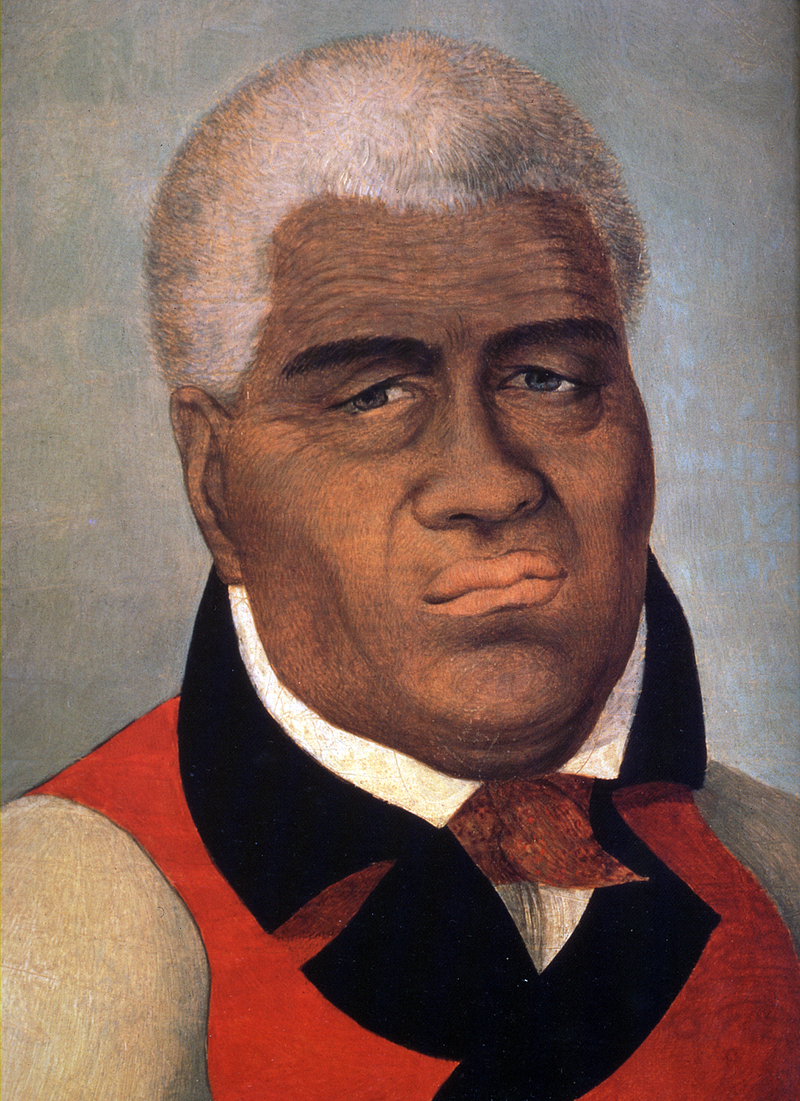
Kamehameha I, c. 1736? – May 8 or 14, 1819, also known as Kamehameha the Great (full Hawaiian name: Kalani Paiʻea Wohi o Kaleikini Kealiʻikui Kamehameha o ʻIolani i Kaiwikapu kauʻi Ka Liholiho Kūnuiākea), was the founder and first ruler of the Kingdom of Hawaii.
Paternity and birth dating Kamehameha was born to Kekuʻiapoiwa II who was the niece of Alapainui, the usurping ruler of Hawaii Island who had killed the two legitimate heirs of Keaweʻīkekahialiʻiokamoku during civil war. By most accounts he was born in Ainakea, Kohala, Hawaii. His father is believed to be Keōua. Native Hawaiian historian Samuel Kamakau states that Maui monarch Kahekili II had hanai adopted (traditional, informal adoption) Kamehameha at birth, as was the custom of the time. Kamakau believes this is why Kahekili II is often referred to as Kamehameha’s father however, the author also tells of how Kame’eiamoku (one of the Royal twins and father of Hoapili) told Kamehameha I that he was actually the son of Kahekili II; “I have something to tell you: Ka-hekili was your father, you were not Keoua’s son. Here are the tokens that you are the son of Ka-hekili.” Kamehameha was a descendant of Keawe through his mother. Keōua acknowledged him as his son and is recognized by most genealogists.
Accounts of Kamehameha I’s birth vary but sources place his birth between 1736 and 1761, with historian Ralph Simpson Kuykendall believing it to be between 1748 – 1761. An early source is thought to imply a 1758 dating due to the significance of the date matching a visit from Halley’s Comet and being close to the age Francisco de Paula Marín estimated.] This dating however, does not work for many well known accounts of the subject such as being a warrior with his uncle, Kalaniʻōpuʻu or being of age to produce his first children. The dating also places his birth after the death of his father.[8] Kamakau published an account in the Ka Nupepa Kuokoa in 1867 placing the date around 1736. He wrote, “It was during the time of the warfare among the chiefs of [the island of] Hawaii which followed the death of Keawe, chief over the whole island (Ke-awe-i-kekahi-aliʻi-o-ka-moku) that Kamehameha I was born”. However, his general dating has been challenged as twenty years too early over issues involving Kamakau’s inaccuracy of dating and the accounts of foreign visitors.Regardless Abraham Fornander wrote in his book, “An Account of the Polynesian Race: Its Origins and Migrations”: “when Kamehameha died in 1819 he was past eighty years old. His birth would thus fall between 1736 and 1740, probably nearer the former than the latter”. “A Brief History of the Hawaiian People” by William De Witt Alexander lists the birth date in the “Chronological Table of Events of Hawaiian History” as 1736. In 1888 the Kamakau account was challenged by Samuel C. Damon in the missionary publication; The Friend, deferring to a 1753 dating that was the first mentioned by James Jackson Jarves. Regardless of this challenge the Kamakau dating was widely accepted due to support from Abraham Fornander.
Concealment, childhood At the time of Kamehameha’s birth, Keōua and his half-brother Kalaniʻōpuʻu were serving Alapaʻinui, ruler of Hawaiiʻs island. Alapaʻinui had brought the brothers to his court after defeating both their fathers in the civil war that followed the death of Keaweʻīkekahialiʻiokamoku. Keōua died while Kamehameha was young, so Kamehameha was raised in the court of his uncle, Kalaniʻōpuʻu. The traditional mele chant of Keaka, wife of Alapainui, indicates that Kamehameha was born in the month of ikuwā (winter) or around November. Alapai had given the child, Kamehameha, to his wife, Keaka, and her sister, Hākau, to care for after the ruler discovered the infant had survived.
On February 10, 1911 the Kamakau version was challenged again by the oral history of the Kaha family, as published in newspaper articles also appearing in the Kuoko. After the republication of the story by Kamakau to a larger English reading public in 1911 Hawaii, this version of the story was published by Kamaka Stillman, who had objected to the Nupepa article.
Kamehameha was raised in the royal court of his uncle Kalaniʻōpuʻu. He achieved prominence in 1782, upon Kalaniʻōpuʻu’s death. While the kingship was inherited by Kalaniʻōpuʻu’s son, Kīwalaʻō, Kamehameha was given a prominent religious position, guardianship of the Hawaiian god of war, Kūkāʻilimoku, as well as control of the district of Waipiʻo valley. The two cousins’ relationship was strained, caused when Kamehameha made a dedication to the gods instead of Kīwalaʻō. Kamehameha accepted the allegiance of a group of chiefs from the Kona district.
The other story is after the Prophecy was passed along by the High Priests/Priestesses and High Chiefs/Chiefesses. The fulfilling of the Prophecy by lifting the Naha Stone, singled out Kamehameha as the fulfiller of the Prophecy. Other ruling Chiefs, Keawe Mauhili, the Mahoe (twins) Keoua and other Chiefs rejected the Prophecy of Ka Poukahi. The High Chiefs of Kauai and supported Kiwalao even after learning about the Prophecy. The five Kona chiefs supporting Kamehameha were: Keʻeaumoku Pāpaʻiahiahi (Kamehameha's father-in-law/grand Uncle), Keaweaheulu Kaluaʻāpana (Kamehameha's uncle), Kekūhaupiʻo (Kamehameha's warrior teacher), Kameʻeiamoku and Kamanawa (twin uncles of Kamehameha). They defended Kamehameha as the Unifier Ka Nai aupuni. High Chiefs Keawe Mauhili and Keeaumoku were by genealogy the next in line for Alii Nui. Both chose the younger nephews Kiwalao and Kamehameha over themselves. Kīwalaʻō was soon defeated in the first key conflict, the Battle of Mokuʻōhai, and Kamehameha and His Chiefs took over Konohiki responsibilities and sacred obligations of the districts of Kohala, Kona and Hāmākua on Hawaiʻi island.
The Prophecy included far more than Hawaiʻi island. It went across and beyond the Pacific Islands to the semi continent of Aotearoa (New Zealand). He was supported by his most political wife Kaʻahumanu and father High Chief Keeaumoku Senior Counselor to Kamehameha, She became one of Hawaiʻi’s most powerful figures. Kamehameha and his Council of Chiefs planned to unite the rest of the Hawaiian Islands. Allies came from British and American traders, who sold guns and ammunition to Kamehameha. Another major factor in Kamehameha’s continued success was the support of Kauai Chief Ka`iana and Captain Brown, who used to be with Kaeo okalani. He guaranteed Kamehameha unlimited gunpowder from China and gave him the formula for gunpowder: sulfur, saltpeter/potassium nitrate and charcoal, all abundant in the islands. Two westerners who lived on Hawaiʻi island, Isaac Davis and John Young, became ohana by marriage and hanai of Kamehameha and trained his troops in the firearm use, maintenance and repair.
Olowalu Massacre In 1789, Simon Metcalfe captained the fur trading vessel the Eleanora while his son, Thomas Humphrey Metcalfe, captained the ship Fair American along the Northwest Coast. They were to rendezvous in what was then known as the Sandwich Islands. Fair American was held up when it was captured by the Spanish and then quickly released in San Blas. The Eleanora arrived in 1790, where it was greeted by chief Kameʻeiamoku. The chief did something that the captain took offense to, and Metcalfe struck the chief with a rope’s end. Sometime later, while docked in Honuaula, Maui, a small boat tied to the ship was stolen by native townspeople with a crewman inside. When Metcalfe discovered where the boat was taken, he sailed directly to the village called Olowalu. There he confirmed the boat had been broken apart and the man killed. He had already fired muskets into the previous village where he was anchored, killing some residents, Metcalfe took aim at this small town of native Hawaiians. He had all cannons moved to one side of the ship and began his trading call out to the locals. Hundreds of people came out to the beach to trade and canoes were launched. When they were within firing range, the ship fired on the Hawaiians, killing over 100. Six weeks later, Fair American was stuck near the Kona coast of Hawaii where chief Kameʻeiamoku was living. He had decided to attack the next foreign ship to avenge the strike by the elder Metcalfe. He canoed out to the ship with his men, where he killed Metcalfe’s son and all but one (Isaac Davis) of the five crewmen. Kamehameha took Davis into protection and took possession of the ship. Eleanora was at that time anchored at Kealakekua Bay, where the ship’s boatswain had gone ashore and been captured by Kamehameha’s forces, because Kamehameha believed Metcalfe was planning more revenge. Eleanora waited several days before sailing off, apparently without knowledge of what had happened to Fair American or Metcalfe’s son. Davis and Eleanora’s boatswain, John Young, tried to escape, but were treated as chiefs, given wives and settled in Hawaii.
Death of Keōua Kuahuula Kamehameha then moved against the district of Puna in 1790 deposing Chief Keawemaʻuhili. Keōua Kūʻahuʻula, exiled to his home in Kaʻū, took advantage of Kamehameha’s absence and led an uprising. When Kamehameha returned with his army to put down the rebellion, Keōua fled past the Kīlauea volcano, which erupted and killed nearly a third of his warriors with its poisonous gas.
When the Puʻukoholā Heiau was completed in 1791, Kamehameha invited Keōua to meet with him. Keōua may have been dispirited by his recent losses. He may have mutilated himself before landing so as to render himself an inappropriate sacrificial victim. As he stepped on shore, one of Kamehameha’s chiefs threw a spear at him. By some accounts he dodged it, but was then cut down by musket fire. Caught by surprise, Keōua’s bodyguards were killed. With Keōua dead, and his supporters captured or slain, Kamehameha became King of Hawaiʻi island.
Maui and Oʻahu In 1795, Kamehameha set sail with an armada of 960 war canoes and 10,000 soldiers. He quickly secured the lightly defended islands of Maui and Molokaʻi at the Battle of Kawela. He moved on to the island of Oʻahu, landing his troops at Waiʻalae and Waikīkī. Kamehameha did not know that one of his commanders, a high-ranking aliʻi named Kaʻiana, had defected to Kalanikūpule. Kaʻiana assisted in cutting notches into the Nuʻuanu Pali mountain ridge; these notches, like those on a castle turret, were to serve as gunports for Kalanikūpule’s cannon.[20][page needed] In a series of skirmishes, Kamehameha’s forces pushed Kalanikūpule’s men back until they were cornered on the Pali Lookout. While Kamehameha moved on the Pali, his troops took heavy fire from the cannon. He assigned two divisions of his best warriors to climb to the Pali to attack the cannons from behind; they surprised Kalanikūpule’s gunners and took control. With the loss of their guns, Kalanikūpule’s troops fell into disarray and were cornered by Kamehameha’s still-organized troops. A fierce battle ensued, with Kamehameha’s forces forming an enclosing wall. Using traditional Hawaiian spears, as well as muskets and cannon, they killed most of Kalanikūpule’s forces. Over 400 men were forced over the Pali’s cliff, a drop of 1,000 feet. Kaʻiana was killed during the action; Kalanikūpule was later captured and sacrificed to Kūkāʻilimoku.
In April 1810, King Kaumualiʻi of Kaua’i became a vassal of Kamehameha, who therefore emerged as the sole sovereign of the unified Hawaiian islands.[21][page needed] Angry over the settlement, several chiefs plotted to kill Kaumualiʻi with poison at the feast in his honor. Isaac Davis got word of this and warned the King who escaped unharmed quietly before the dinner. The poison meant for the king was said to instead have been given to Davis, who died suddenly.
Later life After about 1812, Kamehameha spent his time at Kamakahonu, a compound he built in Kailua-Kona.[citation needed] As was the custom of the time, he had several wives and many children, though he outlived about half of them.
Final resting place When Kamehameha died on May 8 or 14, 1819, his body was hidden by his trusted friends, Hoapili and Hoʻolulu, in the ancient custom called hūnākele (literally, “to hide in secret”). The mana, or power of a person, was considered to be sacred. As per the ancient custom, his body was buried in a hidden location because of his mana. His final resting place remains unknown. At one point in his reign, Kamehameha III asked that Hoapili show him where his father’s bones were buried, but on the way there Hoapili knew that they were being followed, so he turned around.
Family House of Kamehameha Kamehameha had many wives. The exact number is debated because documents that recorded the names of his wives were destroyed. Bingham lists 21, but earlier research from Mary Kawena Pukui counted 26. In Kamehameha’s Children Today authors Ahlo and Walker list 30 wives: 18 that bore children, and 12 that did not. They state the total number of children to be 35: 17 sons, and 18 daughters. While he had many wives and children, his children through his highest-ranking wife, Keōpūolani, succeeded him to the throne. In Ho`omana:
Understanding the Sacred and Spiritual, Chun stated that Keōpūolani supported Kaʻahumanu’s ending of the Kapu system as the best way to ensure that Kamehameha’s children and grandchildren would rule the kingdom.
A statue of him was given to the National Statuary Hall Collection in Washington, D.C. by the state of Hawaii as one of two statues it is entitled to give.
The bulk of Winfrey’s grantmaking has gone to educational causes, including charter schools, programs that support African-American students, and the Oprah Winfrey Leadership Academy in South Africa.
BACKGROUND: Winfrey was born to a single teenage mother in rural Mississippi, and spent the first six years of her life living there with her grandmother before first moving to Milwaukee to live with her mother, and then Nashville to live with her father. The media mogul overcame a tough childhood, but ended up winning an oratory contest that earned her a scholarship to Tennessee State University. She also won the Miss Black Tennessee Beauty Pageant at 17, and attracted the attention of the local black radio station, WVOL, where she worked her senior year of high school, and her first two years of college. She then got jobs as a news anchor, first in Nashville, then in Baltimore, before moving to Chicago to host a morning talk show. The program was wildly successful, and she landed a syndication deal, quickly becoming the most popular talk show host in America. Running from 1986 to 2011, it made Oprah one of the most influential people in the country, as well as the richest African American. In 2000, she launched O Magazine with the Hearst Corporation, and in 2011, she created the Oprah Winfrey Network.
ISSUES:
OPRAH’S ANGEL NETWORK: Oprah’s Angel Network was established in 1998, and started with a plea to her viewers to donate their change, as well as their time. The initial ask raised $3.5 million, which was given away in the form of 150 $25,000 scholarships, and got 15,000 volunteers to build homes for Habitat for Humanity. Before the organization stopped accepting donations in 2010, it had raised more than $80 million, all of which was donated to charitable causes, as Winfrey personally covered the network’s administrative costs. At least $11 million of that went to relief efforts for hurricanes Katrina and Rita, and Oprah herself kicked in another $10 million on top. The network also helped build 60 schools in 13 countries, and provided books and uniforms. Much of the work once conducted through the Angel Network is now being handled by the Oprah Winfrey Charitable Foundation.
EDUCATION: According to Forbes, Winfrey had made approximately $400 million in grants to educational causes by 2012, including nearly 400 scholarships to Morehouse College, and more than $40 million in operating support for the Oprah Winfrey Leadership Academy in South Africa. She has also given at least $10 million to A Better Chance. Its mission is to improve access to quality education for students of color, and has given $1 million or more to at least nine different charter school organizations in a number of different areas throughout the country. Mentoring programs have also received support.
ARTS & CULTURE: Winfrey has donated $12 million to the Smithsonian’s National Museum of African American History and Culture, and $1 million to the National Underground Railroad Freedom Center. The National Council of Negro Women has received $2.5 million, and Millennium Park in Chicago has received $1 million.
HUMANITARIAN: In addition to her giving in education and support for Habitat for Humanity, Winfrey has made several significant contributions to Save the Children.
ENVIRONMENT: In 2006, Oprah made $1 million in grants to the Green Belt Movement International for tree planting and community development initiatives in Africa.
HEALTH: Winfrey’s health grantmaking via her foundation has recently supported places like International Brain Research Foundation.
LOOKING FORWARD: Winfrey has endowed her charitable foundation with nearly $240 million in assets over the last several years. Though most of the money that has flowed out the door so far has gone to support her Leadership Academy in South Africa, it appears as though she is beginning to build a more robust foundation, so chances are we will see a more diversified grantmaking portfolio in the next several years.
CONTACT:
Oprah Winfrey Charitable Foundation ℅ Michele Vaughn 110 N. Carpenter Ave. Chicago, IL 60607 (312) 633-3100
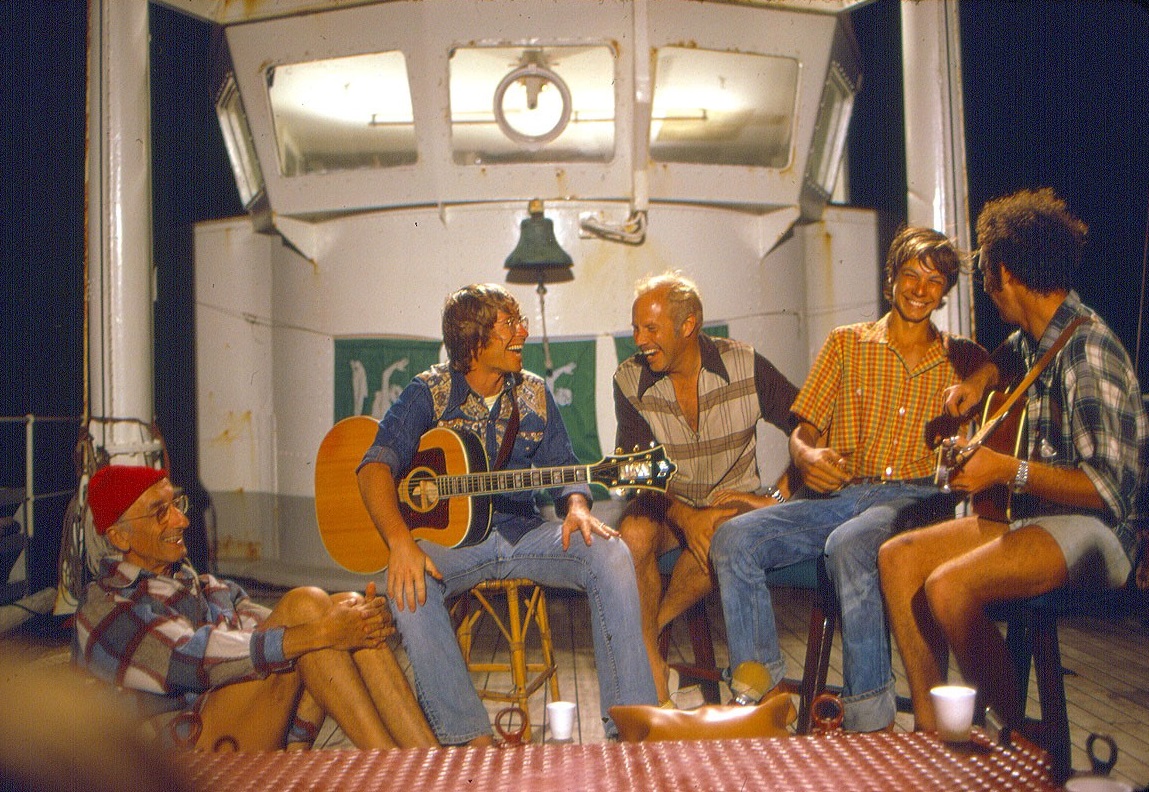
Jacques Cousteau (left) with John Denver on the guitar.
Early years
Cousteau was born on 11 June 1910, in Saint-André-de-Cubzac, Gironde, France, to Daniel and Élisabeth Cousteau. He had one brother, Pierre-Antoine. Cousteau completed his preparatory studies at the Collège Stanislas in Paris. In 1930, he entered the École Navale and graduated as a gunnery officer. After an automobile accident cut short his career in naval aviation, Cousteau indulged his interest in the sea. The accident caused him to break both his arms and could have even killed him. This caused Cousteau to have to change his plans in becoming a naval pilot, but it eventually worked out because of his passion for the ocean.[2]
In Toulon, where he was serving on the Condorcet, Cousteau carried out his first underwater experiments, thanks to his friend Philippe Tailliez who in 1936 lent him some Fernez underwater goggles, predecessors of modern swimming goggles.[1] Cousteau also belonged to the information service of the French Navy, and was sent on missions to Shanghai and Japan (1935–1938) and in the USSR (1939).[citation needed]
On 12 July 1937 he married Simone Melchior, with whom he had two sons, Jean-Michel (born 1938) and Philippe (1940–1979). His sons took part in the adventures of the Calypso. In 1991, one year after his wife Simone’s death from cancer, he married Francine Triplet. They already had a daughter Diane Cousteau (born 1980) and a son, Pierre-Yves Cousteau (born 1982), born during Cousteau’s marriage to his first wife.
Early 1940s: innovation of modern underwater diving
The years of World War II were decisive for the history of diving. After the armistice of 1940, the family of Simone and Jacques-Yves Cousteau took refuge in Megève, where he became a friend of the Ichac family who also lived there. Jacques-Yves Cousteau and Marcel Ichac shared the same desire to reveal to the general public unknown and inaccessible places — for Cousteau the underwater world and for Ichac the high mountains. The two neighbors took the first ex-aequo prize of the Congress of Documentary Film in 1943, for the first French underwater film: Par dix-huit mètres de fond (18 meters deep), made without breathing apparatus the previous year in the Embiez islands (Var) with Philippe Tailliez and Frédéric Dumas, using a depth-pressure-proof camera case developed by mechanical engineer Léon Vèche (engineer of Arts and Métiers and the Naval College).
In 1943, they made the film Épaves (Shipwrecks), in which they used two of the very first Aqua-Lung prototypes. These prototypes were made in Boulogne-Billancourt by the Air Liquide company, following instructions from Cousteau and Émile Gagnan.[3] When making Épaves, Cousteau could not find the necessary blank reels of movie film, but had to buy hundreds of small still camera film reels the same width, intended for a make of child’s camera, and cemented them together to make long reels.[4][5]
Having kept bonds with the English speakers (he spent part of his childhood in the United States and usually spoke English) and with French soldiers in North Africa (under Admiral Lemonnier), Jacques-Yves Cousteau (whose villa “Baobab” at Sanary (Var) was opposite Admiral Darlan‘s villa “Reine”), helped the French Navy to join again with the Allies; he assembled a commando operation against the Italian espionage services in France, and received several military decorations for his deeds. At that time, he kept his distance from his brother Pierre-Antoine Cousteau, a “pen anti-semite” who wrote the collaborationist newspaper Je suis partout (I am everywhere) and who received the death sentence in 1946. However, this was later commuted to a life sentence, and Pierre-Antoine was released in 1954.
During the 1940s, Cousteau is credited with improving the aqua-lung design which gave birth to the open-circuit scuba technology used today. According to his first book, The Silent World: A Story of Undersea Discovery and Adventure (1953), Cousteau started diving with Fernez goggles in 1936, and in 1939 used the self-contained underwater breathing apparatus invented in 1926 by Commander Yves le Prieur.[4] Cousteau was not satisfied with the length of time he could spend underwater with the Le Prieur apparatus so he improved it to extend underwater duration by adding a demand regulator, invented in 1942 by Émile Gagnan.[4] In 1943 Cousteau tried out the first prototype aqua-lung which finally made extended underwater exploration possible.
Late 1940s: GERS and Élie Monnier
In 1946, Cousteau and Tailliez showed the film Épaves (“Shipwrecks”) to Admiral Lemonnier, who gave them the responsibility of setting up the Groupement de Recherches Sous-marines (GRS) (Underwater Research Group) of the French Navy in Toulon. A little later it became the GERS (Groupe d’Études et de Recherches Sous-Marines, = Underwater Studies and Research Group), then the COMISMER (“COMmandement des Interventions Sous la MER”, = “Undersea Interventions Command”), and finally more recently the CEPHISMER. In 1947, Chief Petty OfficerMaurice Fargues became the first diver to die using an aqualung, while attempting a new depth record with the GERS near Toulon.[6]
In 1948, between missions of mine clearance, underwater exploration and technological and physiological tests, Cousteau undertook a first campaign in the Mediterranean on board the sloopÉlie Monnier,[7][8] with Philippe Tailliez, Frédéric Dumas, Jean Alinat and the scenario writer Marcel Ichac. The small team also undertook the exploration of the Roman wreck of Mahdia (Tunisia). It was the first underwater archaeology operation using autonomous diving, opening the way for scientific underwater archaeology. Cousteau and Marcel Ichac brought back from there the Carnets diving film (presented and preceded with the Cannes Film Festival 1951).
Cousteau and the Élie Monnier then took part in the rescue of Professor Jacques Piccard‘s bathyscaphe, the FNRS-2, during the 1949 expedition to Dakar. Thanks to this rescue, the French Navy was able to reuse the sphere of the bathyscaphe to construct the FNRS-3.
The adventures of this period are told in the two books The Silent World (1953, by Cousteau and Dumas) and Plongées sans câble (1954, by Philippe Tailliez).
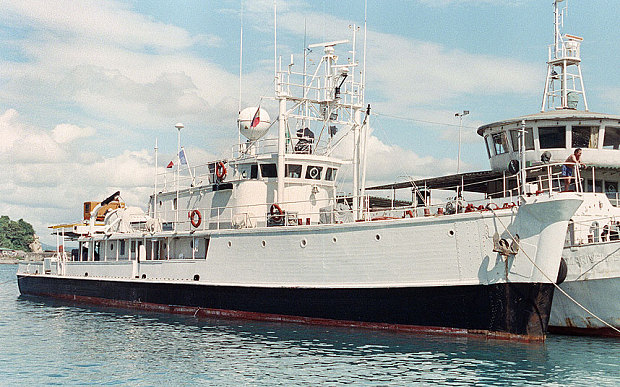
In 1950, he founded the French Oceanographic Campaigns (FOC), and leased a ship called Calypso from Thomas Loel Guinness for a symbolic one franc a year. Cousteau refitted the Calypso as a mobile laboratory for field research and as his principal vessel for diving and filming. He also carried out underwater archaeological excavations in the Mediterranean, in particular at Grand-Congloué (1952).
With the publication of his first book in 1953, The Silent World, he correctly predicted the existence of the echolocation abilities of porpoises. He reported that his research vessel, the Élie Monier, was heading to the Straits of Gibraltar and noticed a group of porpoises following them. Cousteau changed course a few degrees off the optimal course to the center of the strait, and the porpoises followed for a few minutes, then diverged toward mid-channel again. It was evident that they knew where the optimal course lay, even if the humans did not. Cousteau concluded that the cetaceans had something like sonar, which was a relatively new feature on submarines.
In 1954, Cousteau conducted a survey of Abu Dhabi waters on behalf of British Petroleum. Among those accompanying him was Louis Malle who made a black-and-white film of the expedition for the company.[9] Cousteau won the Palme d’Or at the Cannes Film Festival in 1956 for The Silent World co-produced with Malle. In 1957, Cousteau took over as leader of the Oceanographic Museum of Monaco.[2] Afterward, with the assistance of Jean Mollard, he made a “diving saucer” SP-350, an experimental underwater vehicle which could reach a depth of 350 meters. The successful experiment was quickly repeated in 1965 with two vehicles which reached 500 meters.
Cousteau also took part in inventing the “SP-350 Denise Diving Saucer” in 1959 which was an invention best for exploring the ocean floor, as it allowed one to explore on solid ground.[2]
In October 1960, a large amount of radioactive waste was going to be discarded in the Mediterranean Sea by the Commissariat à l’énergie atomique (CEA). The CEA argued that the dumps were experimental in nature, and that French oceanographers such as Vsevelod Romanovsky had recommended it. Romanovsky and other French scientists, including Louis Fage and Jacques Cousteau, repudiated the claim, saying that Romanovsky had in mind a much smaller amount. The CEA claimed that there was little circulation (and hence little need for concern) at the dump site between Nice and Corsica, but French public opinion sided with the oceanographers rather than with the CEA atomic energy scientists. The CEA chief, Francis Perrin, decided to postpone the dump.[11] Cousteau organized a publicity campaign which in less than two weeks gained wide popular support. The train carrying the waste was stopped by women and children sitting on the railway tracks, and it was sent back to its origin.
In the 1960s Cousteau was involved with a set of three projects to build underwater “villages”; the projects were named Precontinent I, Precontinent II and Precontinent III. Each ensuing project was aimed at increasing the depth at which people continuously lived under water, and were an attempt at creating an environment in which men could live and work on the sea floor. The projects are best known as Conshelf I (1962), Conshelf II (1963), and Conshelf III (1965). The names “Precontinent”, and “Continental Shelf Station” (Conshelf) were used interchangeably by Cousteau.
A meeting with American television companies (ABC, Métromédia, NBC) created the series The Undersea World of Jacques Cousteau, with the character of the commander in the red bonnet inherited from standard diving dress intended to give the films a “personalized adventure” style. This documentary television series ran for ten years from 1966 to 1976. A second documentary series, The Cousteau Odyssey, ran from 1977 to 1982 on public television stations.
In 1970, he wrote the book The Shark: Splendid Savage of the Sea with his son Philippe. In this book, Cousteau described the oceanic whitetip shark as “the most dangerous of all sharks”.
In December 1972, two years after the volcano’s last eruption, The Cousteau Society was filming Voyage au bout du monde on Deception Island, Antarctica, when Michel Laval, Calypso’s second in command, was struck and killed by a rotor of the helicopter that was ferrying between Calypso and the island.[12][13]
In 1973, along with his two sons and Frederick Hyman, he created the Cousteau Society for the Protection of Ocean Life, Frederick Hyman being its first President.
In 1975, John Denver released the tribute song “Calypso” on his album Windsong, and on the B-side of his hit song “I’m Sorry“. “Calypso” became a hit on its own and was later considered the new A-side, reaching #2 on the charts.
In 1976, Cousteau located the wreck of HMHS Britannic. He also found the wreck of the French 17th-century ship-of-the-line La Therese in coastal waters of Crete.
In 1977, together with Peter Scott, he received the UN International Environment prize.
On 28 June 1979, while the Calypso was on an expedition to Portugal, his second son Philippe, his preferred and designated successor and with whom he had co-produced all his films since 1969, died in a PBY Catalina flying boat crash in the Tagus river near Lisbon. Cousteau was deeply affected. He called his then eldest son, the architect Jean-Michel, to his side. This collaboration lasted 14 years.
On 24 November 1988, he was elected to the Académie française, chair 17, succeeding Jean Delay. His official reception under the cupola took place on 22 June 1989, the response to his speech of reception being given by Bertrand Poirot-Delpech. After his death, he was replaced by Érik Orsenna on 28 May 1998.
In June 1990, the composer Jean Michel Jarre paid homage to the commander by entitling his new album Waiting for Cousteau. He also composed the music for Cousteau’s documentary “Palawan, the last refuge”.
On 2 December 1990, his wife Simone Cousteau died of cancer.
In June 1991, in Paris, Jacques-Yves Cousteau remarried, to Francine Triplet, with whom he had (before this marriage) two children, Diane and Pierre-Yves. Francine Cousteau currently continues her husband’s work as the head of the Cousteau Foundation and Cousteau Society. From that point, the relations between Jacques-Yves and his elder son worsened.
In November 1991, Cousteau gave an interview to the UNESCO Courier, in which he stated that he was in favour of human population control and population decrease. Widely quoted on the Internet are these two paragraphs from the interview: “What should we do to eliminate suffering and disease? It’s a wonderful idea but perhaps not altogether a beneficial one in the long run. If we try to implement it we may jeopardize the future of our species…It’s terrible to have to say this. World population must be stabilized and to do that we must eliminate 350,000 people per day. This is so horrible to contemplate that we shouldn’t even say it. But the general situation in which we are involved is lamentable”.[15]









 Sketches of Spain (And Other Things)