

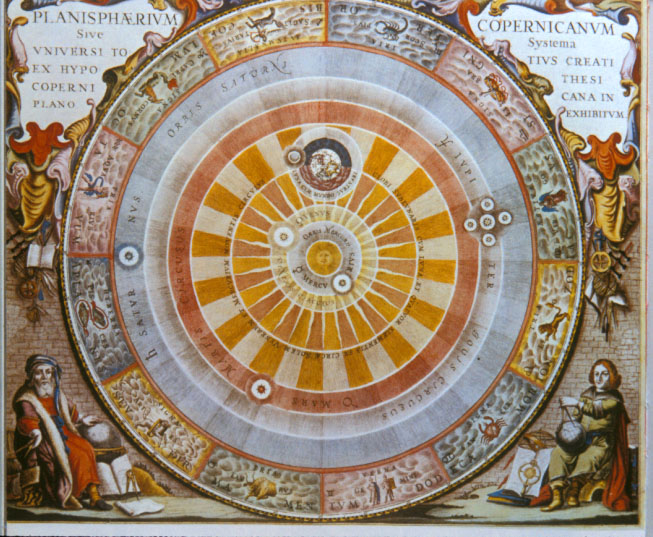
In the whole world prior to Galileo’s conflict with the Church, the majority of educated people subscribed either to the Aristotelian geocentric view that the earth was the center of the universe and that all heavenly bodies revolved around the Earth, or the Tychonic system that blended geocentrism with heliocentrism.[
Opposition to heliocentrism and Galileo’s writings combined scientific and religious objections. Scientific opposition came from Tycho Brahe and others and arose from the fact that, if heliocentrism were true, an annual stellar parallax should be observed, though none was. Copernicus and Aristarchus had correctly postulated that parallax was negligible because the stars were so distant. However, Brahe had countered that, since stars appeared to have measurable angular size, if the stars were that distant and their apparent size was due to their physical size, they would be far larger than the Sun. (In fact, it is not possible to observe the physical size of distant stars without modern telescopes). In Brahe’s system the stars were a little more distant than Saturn, and the Sun and stars were comparable in size.[
Religious opposition to heliocentrism arose from Biblical references such as Psalm 93:1, 96:10, and 1 Chronicles 16:30 which include text stating that “the world is firmly established, it cannot be moved”. In the same manner, Psalm 104:5 says, “the Lord set the earth on its foundations; it can never be moved”. Further, Ecclesiastes 1:5 states that “the sun rises and sets and returns to its place”.[
Galileo defended heliocentrism based on his astronomical observations of 1609 (Sidereus Nuncius 1610). In December 1613, the Grand Duchess Christina of Florence confronted one of Galileo’s friends and followers, Benedetto Castelli, with biblical objections to the motion of the earth. According to Maurice Finocchiaro, this was done in a friendly and gracious manner, out of curiosity. Prompted by this incident, Galileo wrote a letter to Castelli in which he argued that heliocentrism was actually not contrary to biblical texts, and that the bible was an authority on faith and morals, not on science. This letter was not published, but circulated widely.[
By 1615, Galileo’s writings on heliocentrism had been submitted to the Roman Inquisition by Father Niccolò Lorini, who claimed that Galileo and his followers were attempting to reinterpret the Bible, which was seen as a violation of the Council of Trent and looked dangerously like Protestantism.[73] Lorini specifically cited Galileo’s letter to Castelli. Galileo went to Rome to defend himself and his Copernican and biblical ideas. At the start of 1616, Monsignor Francesco Ingoli initiated a debate with Galileo, sending him an essay disputing the Copernican system. Galileo later stated that he believed this essay to have been instrumental in the action against Copernicanism that followed. According to Maurice Finocchiaro, Ingoli had probably been commissioned by the Inquisition to write an expert opinion on the controversy, and the essay provided the “chief direct basis” for the Inquisition’s actions. The essay focused on eighteen physical and mathematical arguments against heliocentrism. It borrowed primarily from the arguments of Tycho Brahe, and it notedly mentioned Brahe’s argument that heliocentrism required the stars to be much larger than the Sun. Ingoli wrote that the great distance to the stars in the heliocentric theory “clearly proves … the fixed stars to be of such size, as they may surpass or equal the size of the orbit circle of the Earth itself.” The essay also included four theological arguments, but Ingoli suggested Galileo focus on the physical and mathematical arguments, and he did not mention Galileo’s biblical ideas.[ In February 1616, an Inquisitorial commission declared heliocentrism to be “foolish and absurd in philosophy, and formally heretical since it explicitly contradicts in many places the sense of Holy Scripture”. The Inquisition found that the idea of the Earth’s movement “receives the same judgement in philosophy and … in regard to theological truth it is at least erroneous in faith”. (The original document from the Inquisitorial commission was made widely available in 2014.[80])
 Sketches of Spain (And Other Things)