Time of the Sixth Sun is an inspirational and uplifting documentary film about the shift in global consciousness and the emerging movement to find a new way to walk more lightly on this Earth. Our ancestors understood our symbiotic relationship to nature and the elements, and foresaw the collapse of an unsustainable world. Filmed predominantly in North America, Mexico, Peru, S.Africa, India, Egypt, Israel and Australia, this film is a synergy of ancient wisdom from the indigenous Elders and insights from pioneers of new energy consciousness, who collaboratively hold the vision of a new earth experience.The film is introduced by Greta Scacchi and narrated by ‘Tobias’, an angelic being who has lived many lifetimes on Earth, channeled by Geoffrey Hoppe. Our crew flew to Colorado and whilst Geoffrey was in a trance state, we asked Tobias if he would tell our story. He called it ‘the biggest evolution of consciousness humanity has ever experienced’.“You are witnessing the dissolving of old systems and the birth of new energy consciousness. It is time to re-member who you are and why you are here, at this time of the greatest change ever.” (Tobias)
The power of this film is carried in the transmission of both the narrator and the speakers, and is interwoven with ceremony and the visual journey of the film’s ‘everyman’, a modern day musical troubadour.
A montage of sound and visuals create a sonic tapestry, inviting the viewer into an intimate and authentic experience of a world in transition. A sensory feast that promises to be as impactful on the ear as it is on the eye, whilst an original soundtrack seamlessly weaves sacred songs, prayers and chants with the resonant strings of Estas Tonne, virtuoso guitarist and troubadour on his journey. A meditation for the soul.
NEW WISDOM KEEPERS BRIDGE THE WORLDS
“A Cree Indian prophecy states… “When the earth has been ravaged and the animals are dying, a tribe of people from all races, creeds and colours will put their faith in deeds, not words, to make the land green again. They will be called “Warriors of the Rainbow, Protectors of the Environment.”
People across the globe are awakening by the millions, seeking a truth that lies beyond political spin and cheap sound bytes. From east to west, many are answering the call to awaken and these Rainbow Warriors are now spreading a message of unity across the globe, no longer willing to be divided by the old paradigm of duality. The polarities are stretched to their limit and the old operating system needs updating.
This film explores our awakening process from the point of seeding the planet through to the point of our ascension as we move into a more evolved state of being and ascend to a higher level of collective consciousness.
Change is undeniably afoot and we are seeing it in the streets across the world as people stand up against their corrupt governments and the banking elite. People are beginning to seek their sovereignty and their independence from a dying Dragonian system that no longer serves them. It is on the screens everywhere from the Occupy movement to the global fight against fracking to the desire to see Ecocide become an international crime.
“To the world governments…“Step up, consult, sit down and gather with the shamans, the healers, the practitioners, the spiritual elders. Sit down and create a new system.” (Dr Stuart Jemesen)
But amidst a world in turmoil, there are those warriors who have been reconnecting with their ancestral roots and in answering their call to awaken, are now re-connecting with the indigenous Elders, who in turn are sharing their oral traditions and knowledge. As this generation of indigenous wisdom keepers return home to Spirit, will these rainbow warriors now become the wisdom keepers of the future?
“Our ceremonial Elders are making returns to Spirit; leaving now the new forms and silhouettes of present day. New medicine tools are to be in the forms of discovered technologies and cultural creatives; storytellers, filmmakers, artists and musicians. This multitude of orators, diverse in walks, locations and philosophies, each given the gift of watch and teaching.” (Uqualla – Spiritual Emissary of the Havasupai Tribe)
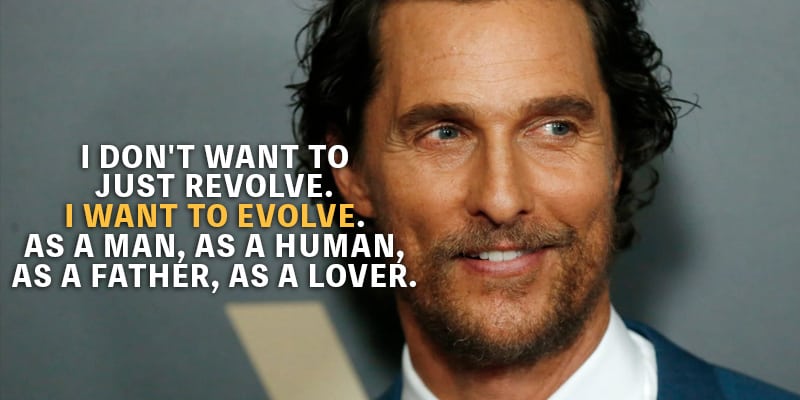
Matthew McConaughey has lived a life of great success, a life many would dream about living. Here he shares his greatest life lessons in one of the best commencement speeches ever, at the University of Houston.
1. Life Isn’t Easy or Fair
Nothing good in life ever comes easy. Think about the last time you worked hard for a particular goal. How did it feel to finally achieve it? Don’t feel entitled to things and don’t play the victim. As Muhammad Ali said once, the service to others is the rent you pay for your room here on earth.
Take full responsibility for what is good and bad in your life and keep moving forward. Don’t expect life to be easy. When you’re a hard worker, it doesn’t matter if life is hard.
2. “Unbelievable” is the Stupidest Word in the Dictionary
Never be too flabbergasted by anything that you fail to give credit to the person who created it. For example, Elon Musk’s plan to dig down the surface of the earth and building cascading lanes for traffic sounds “unbelievable”.
But if you look closely, there’s nothing unbelievable. It’s an exceptional feat but anything is possible with human creativity. Think about the invention of airplanes, the electric bulb, internet, virtual reality – it’s all unbelievable until you realize your own power.
3. Happiness is Different Than Joy
“If happiness is what you’re after, then you are going to be let down frequently and be unhappy much of your time. Joy, though, is something else. It’s not a choice, not a response to some result, it is a constant. Joy is “the feeling we have from doing what we are fashioned to do,” no matter the outcome.”
Happiness is a response to an external outcome – getting a raise at work, seeing the face of your newborn, or meeting an old friend after a long time. It is a conditional, an if-then thing. But joy, we feel, when we are doing something that we are meant to do. For some, it is playing sports, for others, it is building an exceptional physique.
As they say, follow your bliss. Find what you enjoy in life and do more of it. Matthew McConaughey says that when he started to enjoy the making of a movie, the deed itself, instead of treating it as a means to an end, i.e. the respect of his peers or awards, he surprisingly received more awards and more respect. In other words, when you can enjoy your craft, you’ll naturally work harder and the results will be great naturally.
4. Define Success For Yourself
“Whatever your answer is, don’t choose anything that will jeopardize your soul. Prioritize who you are, who you want to be.”
Matthew McConaughey says that we should always keep asking ourselves an important question: “What success means for me? It might be getting rich, raising a healthy family, a happy marriage, or attaining spiritual enlightenment.
“DON’T DRINK THE KOOL AID!!It tastes sweet today but it will give you cavities tomorrow. Life is not a popularity contest. Be brave, take the hill but first, answer the question, “What is my hill?”
5. Process of Elimination is the First Step to Our Identity
The first step to self-actualization, to discover who we are, is to first discover what we are not. It’s only by heading into the wrong direction and hitting a wall, people realize that they have to change their ways.
According to Matthew McConaughey,
“The first step that leads to our identity in life is usually NOT “I know who I am,” but rather “I know who I AM NOT.” Process of elimination.”
For example, sometimes you spend time with friends or colleagues who gossip a lot, complain a lot about how President Trump is ruining their lives, the dog on the street irritates them every morning, and how their spouse is the real reason they’re not making any progress at work.
When we realize that people or places make us feel unpleasant, it’s essential that we stop visiting them again. It’s essential to weed out “what you’re not” to become “what you are”.
6. DON’T LEAVE CRUMBS — and the beauty of delayed gratification
Crumbs are the choices we make today that haunt us in the future, they make us look over our shoulder. They makes us feel regret, guilt, and remorse. For example, you didn’t prepare well for the job and it breaks your spirit to see your colleague getting promoted but not you. You drank too much last night and now you fear that you will blow the presentation. Or you lied to your wife about where you are but she finds out from the text message on your phone later.
Matthew McConaughey says that instead of leaving crumbs for the future, why not plant seeds of goodness for the future. For example, you work harder than required on a project and it impresses the manager so much that they give you an even bigger opportunity.
“So…let’s flip the script. Instead of creating outcomes that take FROM us, let’s create MORE outcomes that pay us BACK, fill us up, keep your fire lit, turn you ON, for the most amount of TIME in your future. These are the choices I speak of and this is the beauty of delayed gratification.” – Matthew McConaughey
7. DISSECT YOUR SUCCESSES (Gratitude Reciprocates)
According to Matthew McConaughey, the only time we stop and assess ourselves is when we fall down. We only gossip about others’ shortcomings, we only write in our diaries when we’re feeling sad.
But if we start to dissect our successes more often, we’ll find that we will have more successes. This is a lesson in gratitude. The more you thank the universe for what you have, the more you will have to thank for.
8. Make Voluntary Obligations
Society wants us to fulfill some responsibilities, to not deviate from morals and ethics, to become productive members of society. But the most important obligations are the ones we put on ourselves. Because when you deviate from your own values, it’ll be hard to go to sleep at night.
So make sure you always follow this personal protocol to have a peaceful life.
“An honest man’s pillow is his peace of mind, and when you lay down on the pillow at night, no matter who’s in our bed we ALL sleep alone. — These are your personal jiminy crickets. And there are not enough cops in the entire world to police them — It’s on YOU.” – Matthew McConaughey
9. From Can to Want
Don’t say yes to opportunities just because you can. Say yes because you want to. Many people never leave jobs they hate because they can get promoted even though they don’t want to do the work. They’d be better off opening their own yoga studio or becoming a fitness coach, but they keep doing soulless work for money.
Say yes to what you want before it’s too late.
Consider the example of Peter Dinklage, the Lannister from Game of Thrones. He spent 6 years doing data processing, a job he hated to the core, before he finally took a low-paying acting gig. The point is that, never do things because they’re available to you, do them because you want to.
“Just because you CAN?… Nah… It’s not a good enough reason to do something. Even when it means having more, be discerning, choose it, because you WANT it, DO IT because you WANT to.” – Matthew McConaughey
10. A Roof is a Man Made Thing
“It’s because we have created a fictitious ceiling, a roof, to our expectations of ourselves, a limit — where we think it’s all too good to be true. BUT IT ISN’T. AND IT’S NOT OUR RIGHT TO SAY OR BELIEVE IT IS.” – Matthew McConaughey
We often put limitations on our abilities, our self-belief, on what we deserve. So when something beyond those limits happens to us, when we are called to interview for an influential position, when we get a chance to talk to our crush, we freeze inside and can’t control the situation.
But if we were instead focused on the experience, enJOYing the craft as discussed earlier, it wouldn’t matter. The point is to enjoy and focus on the process so much that you score a goal without making it a big deal. The goal, the “big moment” becomes just another part of the process.
11. Turn the page
We often keep running in circles in life. No matter how hard we try to change things for the better, something keeps us taking back to where we were. In this merry-go-round, what we have to realize is that we are the authors of our own story.
The mistake we make is that we believe we can’t change, change is hard, or external things are to blame. But if we realize our power, to create life on our own terms, then change will come easy. First we have to make the internal shift.
“You ever get in a rut? Stuck on the merry-go-round of a bad habit? I have. You are going to make mistakes — own them, make amends, and move on. Guilt and regret kills many a man before their time. Turn the page, get off the ride. YOU are the author of the book of your life. Turn the page.”
12. Give Your Obstacles Credit
You don’t need to eliminate your fears or obstacles. Nah! Admit that they exist and then cross them anyway. When you reach the other side, you’ll realize how good you feel because you took that courageous step.
“Well, instead of denying these fears, declare them, say them out loud, admit them, give them the credit they deserve…..Find the courage to overcome them or see clearly that they are not really worth prevailing over.” – Matthew McConaughey
13. So how do we know when we cross the truth?
Matthew McConaughey takes 21-day trips by himself to get away from the noise of the world. He travels to places where nobody speaks his language and knows him by his name. These adventures serve as a purge, a cleansing ritual for him. He was tired, anxious, and confused about his newfound fame, so he went to Peru.
And on the 13th day, he “crossed the truth”.
As he was going for a walk, he turned a corner and there was this beautiful scenario – a thousand butterflies in front of him. No way further. He had an epiphany. He realized that “All I want is what I can see, and what I can see, is in front of me.” In that moment, he let go of all anxieties, guilt, anticipation and fully embraced the present moment.
To cross your own truth, you have to get away from the noise. Go away for a weekend to be with yourself and see what you find.
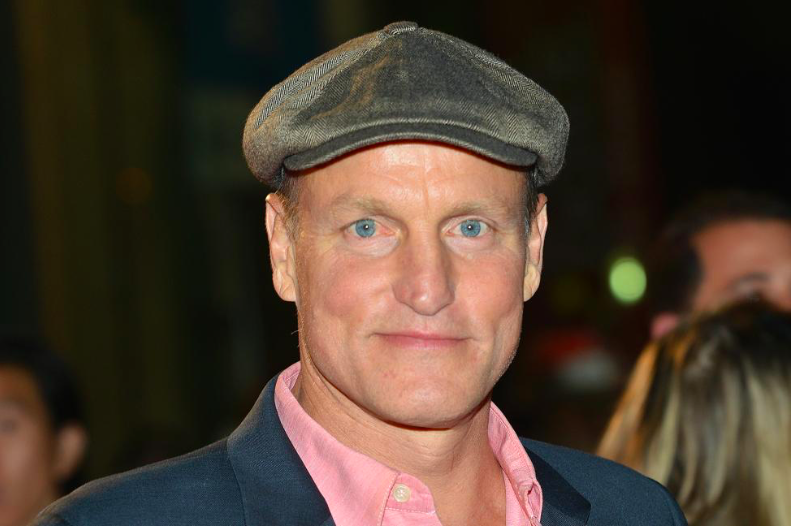
It’s November in London and it’s cold in the room, but Woody Harrelsonhas brought the Texas heat with him. His eyes are alight and he speaks in warm gusts, like a hill-country preacher after a shot of straight bourbon. He’s talking peace and love, freedom and repentance. He reckons he’s found an alternative path, towards a land of clean air, raw food and legalised marijuana. How cool it would be if America came too.
While I’d think twice before hitching my wagon to so wayward a star, I’m always delighted to see Harrelson on the screen. His very presence guarantees that the ride will be interesting – and often actively wild. I loved him in his corn-fed, handsome youth, playing the dopey junior bartender in Cheers, and I adore him in his dented, haunted middle age, lost in the bayou on True Detective. In person, too, the man can be devilishly good company, a natural born spellbinder. Sometimes to the point where he bamboozles himself.
“It would not be unfair to call me an anarchist,” he declares at one point, after the herbal tea has kicked in and the air-con has been switched off. “Because I am really not a believer in big government. If you mention big government, that sends up a lot of red flags.” He frowns at his hands, mentally re-weighs the evidence. “I suppose, in a limited way, big government is necessary.”
The actor is in town to plug his role in Mockingjay – Part 2, the stentorian final stanza of the Hunger Games franchise, in which rebels unseat the old order in a parallel US. He has also just played Lyndon B Johnson, the great bear of big government, in a new film for Rob Reiner called LBJ. He was in Dallas last week; they re-created the motorcade by the old book depository. What with LBJ and The Hunger Games,he’s been thinking a lot about politics and power, and how noble ideals can be turned inside out.Play VideoPlayCurrent Time 0:00/Duration Time0:00Loaded: 0%Progress: 0%FullscreenMuteFacebookTwitterPinterest
He arranges himself on the couch, a vision in autumnal browns, clad in lightweight hemp fabric that can’t quite keep out the chill. “Of course, we live in a completely corrupted world where every government is just a bunch of businessmen working for a bunch of bigger businessmen and none of them give a shit about the people,” he says. “The sad fact is no one knows how to change it, because no one knows how to take on the corporations. So I guess we’re stuck with this system until the oil runs out.”
LBJ is a case in point. Harrelson loved playing the man; he became obsessed with the role. He has spent most of this morning still reading about him. “Now Johnson was a colourful character, and he did a lot of good things. Civil rights, war on poverty, endowments for the arts. But then he gets bogged down in Vietnam and becomes like every other president. He has to go along to get along. That’s the tragedy.”
Read more
He takes a mouthful of tea and shakes his head. He suspects there are wider factors at work and that the rot set in early; some vital connection was lost. “In the US, when white folks came on to the land and declared they discovered it in spite of the millions of people who inhabited it already, they actually adopted a lot of what became our government from the Iroquois confederacy.” He draws a breath. “But the crucial thing they left out was something called the council of women elders. And I really like the idea of a council of women elders. These people who have nothing to gain and who aren’t influenced by money and do good for the people. It would be nice to get something like that going again now.”
Harrelson was born at the start of the 60s, in Midland, Texas, then relocated to Ohio on the cusp of his teens. The family was devoutly religious. Harrelson was a schoolboy preacher and attended a Presbyterian college. I’ve read that he was raised by his mother, his grandmother and his great-grandmother, Polly. It sounds like his own personal council of women elders.
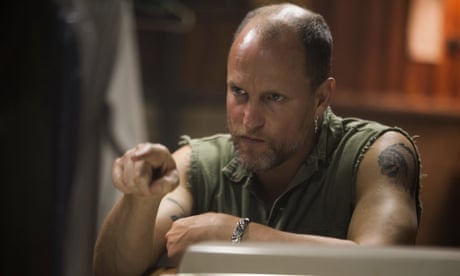
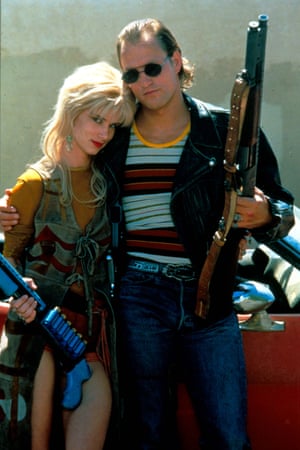
Juliette Lewis and Woody Harrelson in 1994’s Natural Born Killers. Photograph: Moviestore/Rex Shutterstock
“That’s right, I suppose it was. It was very matriarchal in my family. And it still is, very similar. I’ve got three daughters, the goddesses. And there’s my wife. And the dog is female. And so is the cat. Females, females everywhere. I like a lot of yin energy. I’m very appreciative of women. I’m talking generally, not in the romantic sense, that’s a whole separate thing.” Another breath. “Although it’s true I’m appreciative of them in that sense as well.”
Where was his father in all this? Was he ever discussed? But raising the subject of his dad pulls Harrelson up short. He turns very still. His blue eyes freeze over. “Umm,” he says. “I guess I should have seen that segue was coming.”
Charles Harrelson was a contract killer, convicted for the murder of a grain dealer and then later for the shooting of a federal judge. He once bragged that he had had a hand in the Kennedy assassination. Conspiracy theorists put him as the youngest of the three tramps in the railyards near Dealey Plaza. It’s a dark and curious tale, but not one the actor is keen to revisit in public.
“Well, he was gone,” he says simply. “He was gone much of the time, since he was in prison from the time I was seven, except for a year and a half respite, right through to his death. It sounds pretty sad and pathetic, but that’s just how life was. Kids don’t walk around saying, ‘Oh, I’ve got this terrible situation.’ They just get on with being kids.”Advertisement
Does he find he thinks about his father more now that he’s older? “Umm. I do think about him, sure. But those aren’t the things that preoccupy me. I mean, that’s the past. You don’t forget the past. You carry it with you, and hopefully learn from it. But you live in the present.”
Harrelson, like America, was born out of bloodshed and religion. Like America, too, he grew too big too quickly, when he was young, brash and headstrong. Not long out of college, he landed his breakthrough gig in Cheers, a lovable sitcom about losers and boozers in a Boston bar “where everybody knows your name”. After that came roles as a psycho-killer in Natural Born Killers and a paraplegic pornographer in The People vs Larry Flynt. But stardom spun his head. He drank too deeply, sowed his oats too freely, and had a number of run-ins with the police. It took time to straighten out and settle down.
“I was 24 when I became famous,” he says. “And that’s a big adjustment. Even the most amazing people get tainted. And I got drunk on success. My ego flared up. There’s a lot of asshole things that I did that I can never take back. I carry a whole fricking boatload of regrets – too many to mention. We’d be here all day.”
An assistant glides in to drape a fleece over his shoulders. He says: “The principal trouble with the entertainment industry – and I’ve seen it a lot, I’ve been hanging around 30 years and I’ve met everybody – is ego.” Another pause. “You have a person who has a hole in their life and they want it to be filled with attention and love. Maybe they didn’t get enough love as a kid. Maybe they’re a glutton for love. Or maybe we all just want love, period.
“So you become a famous rock star or actor, and you’re getting all this love from people who don’t know you. And it’s just a total head trip. It solves the initial problem, but the hole is not going to be filled up with that silly putty. It needs something real. It’s been a long enough journey that I feel I’ve evolved into a much better person. But I still feel I’ve got a hell of a long way to go.”
He credits his wife, Laura, and the three goddesses (two of whom have now departed for college) with providing a solid foundation. He credits his home in Hawaii for keeping Hollywood at arm’s length. “Oh, Hawaii,” he enthuses. “That’s the most amazing oasis. An incredible community of people who love each other and look out for each other and you don’t worry when the kids play out in the neighbourhood. Everybody knows everybody.”
He’s making it sound like the bar back in Cheers. “Well, I guess,” shrugs Harrelson. “But, you know, real.”
“If today’s arts love the machine, technology and organization, if they aspire to precision and reject anything vague and dreamy, this implies an instinctive repudiation of chaos and a longing to find the form appropriate to our times.”
The Bauhaus was arguably the single most influential modernist art school of the 20th century. Its approach to teaching, and to the relationship between art, society, and technology, had a major impact both in Europe and in the United States long after its closure under Nazi pressure in 1933. The Bauhaus was influenced by 19th and early-20th-century artistic directions such as the Arts and Crafts movement, as well as Art Nouveau and its many international incarnations, including the Jugendstil and Vienna Secession. All of these movements sought to level the distinction between the fine and applied arts, and to reunite creativity and manufacturing; their legacy was reflected in the romantic medievalism of the Bauhaus ethos during its early years, when it fashioned itself as a kind of craftsmen’s guild. But by the mid-1920s this vision had given way to a stress on uniting art and industrial design, and it was this which underpinned the Bauhaus’s most original and important achievements. The school is also renowned for its extraordinary faculty, who subsequently led the development of modern art – and modern thought – throughout Europe and the United States.
KEY IDEAS
The origins of the Bauhaus lie in the late 19th century, in anxieties about the soullessness of modern manufacturing, and fears about art’s loss of social relevance. The Bauhaus aimed to reunite fine art and functional design, creating practical objects with the soul of artworks.Although the Bauhaus abandoned many aspects of traditional fine-arts education, it was deeply concerned with intellectual and theoretical approaches to its subject. Various aspects of artistic and design pedagogy were fused, and the hierarchy of the arts which had stood in place during the Renaissance was levelled out: the practical crafts – architecture and interior design, textiles and woodwork – were placed on a par with fine arts such as sculpture and painting.From Our SponsorReport AdGiven the equal stress it placed on fine art and functional craft, it is no surprise that many of the Bauhaus’s most influential and lasting achievements were in fields other than painting and sculpture. The furniture and utensil designs of Marcel Breuer, Marianne Brandt, and others paved the way for the stylish minimalism of the 1950s-60s, while architects such as Walter Gropius and Ludwig Mies van der Rohe were acknowledged as the forerunners of the similarly slick International Style that is so important in architecture to this day.The stress on experiment and problem-solving which characterized the Bauhaus’s approach to teaching has proved to be enormously influential on contemporary art education. It has led to the rethinking of the “fine arts” as the “visual arts”, and to a reconceptualization of the artistic process as more akin to a research science than to a humanities subject such as literature or history.
In his early career Walter Gropius worked for an international conglomerate designing everything from architectural and industrial projects to office lighting and stationary – this led him to envision a total design ethos, employing “a new guild of craftsmen,” that he later embodied in founding the Bauhaus.
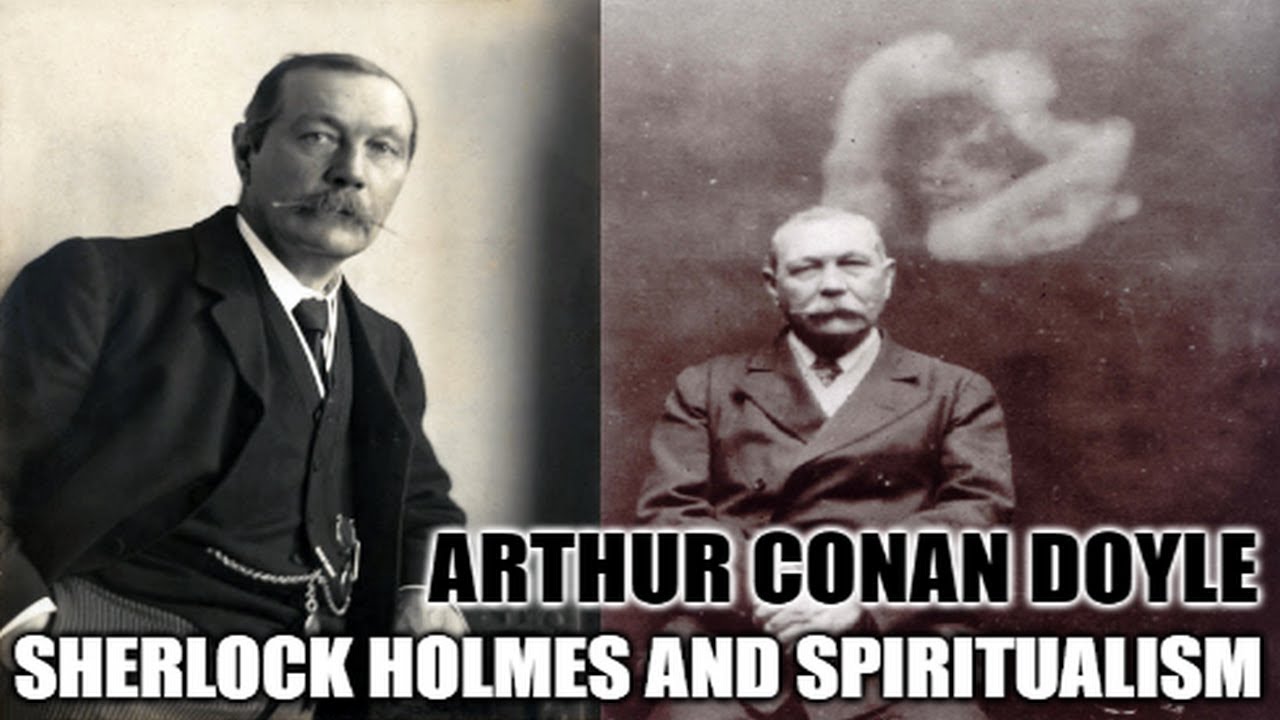
In October 1916, Arthur Conan Doyle, famous for his Sherlock Holmes tales, announced in the journal Light his conversion to spiritualism. During the last years of his life, he became the “crusader” of this movement that preaches salvation of humanity through science.
Thus, from 1920 to 1923, he gave a series of lectures about spiritualism in Australia, in USA and in Canada. He published his autobiography, Memories and Adventures in 1924 and opened a bookstore dedicated to spiritualism, The Psychic Bookshop in London, where he handled the editing of his own works. In particular he published The History of Spiritualism in two volumes and The Land of Mist, the latest adventure of Professor Challenger on a spiritualism topic.
He spent more time on lectures: in 1925 in Paris, at the International Spiritualist Congress; in 1928 in London, at the Congress he chaired himself, and then in South Africa, Rhodesia, Kenya, Holland, and the Scandinavian countries. After these trips, in 1929, exhausted, he suffered a heart attack.
Nevertheless, against the advice of his doctors, he insisted on speaking at a ceremony commemorating the Armistice, then spent weeks in bed. He recovered slowly but on 7 july 1930 at dawn, he died from a final heart attack. His last words to his wife at his side were “You are wonderful”.
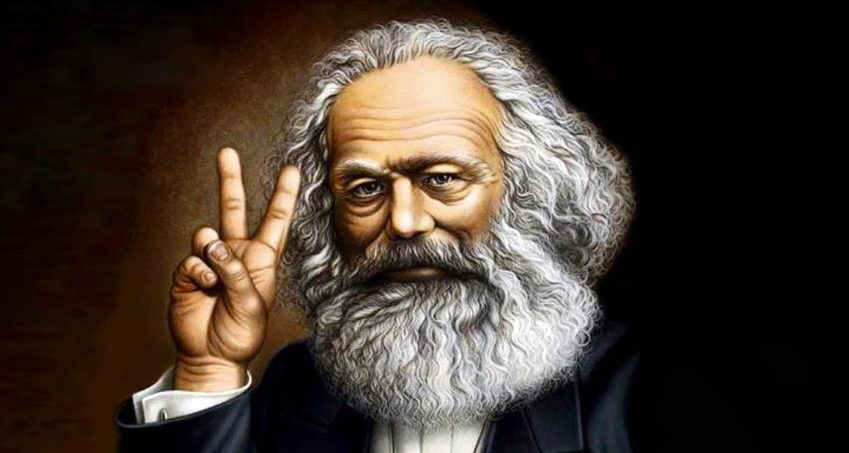
Karl Marx (1818-1883) was a philosopher, author, social theorist and economistfamous for his theories about capitalism and communism. Marx, in conjunction with Friedrich Engels, published The Communist Manifesto in 1848; later in life, he wrote Das Kapital (the first volume was published in Berlin in 1867; the second and third volumes were published posthumously in 1885 and 1894, respectively), which discussed the labor theory of value. Ironically, Marx was eloquent in describing the exploitation of the working class while personally failing to maintain a job for a significant period of time.
Marx was inspired by classical political economists such as Adam Smith and David Ricardo, while his own branch of economics, Marxian economics, is not favored among modern mainstream thought. Nevertheless, Marx’s ideas have had a huge impact on societies, most prominently in communist projects such as those in the USSR, China, and Cuba. Among modern thinkers, Marx is still very influential among the fields of sociology, political economy and strands of heterodox economics.
While many equate Karl Marx with socialism, his work on understanding capitalism as a social and economic system remains a valid critique in the modern era. In Das Kapital (or Capital in Eglish), Marx argues that society is composed of two main classes: Capitalists are the business owners who organize the process of production and who own the means of production such as factories, tools and raw material, and who are also entitled to any and all profits. The other, much larger class is composed of labor (which Marx termed the “proletariat”). Laborers do not own or have any claim to the means of production, the finished products they work on, or any of the profits generated from sales of those products. Rather, labor works only in return for a money wage. Marx argued that because of this uneven arrangement, capitalists exploitworkers.
Another important theory developed by Marx is known as historical materialism. This theory posits that a society at any given point in time is ordered by the type of technology used in the process of production. Under industrial capitalism, society is ordered with capitalists organizing labor in factories or offices where they work for wages. Prior to capitalism, Marx suggested that feudalism existed as a specific set of social relations between lord and peasant classes related to the hand-powered or animal-powered means of production prevalent at the time.
BREAKING DOWN Karl Marx
Marx’s work laid the foundations for future communist leaders such as Vladimir Lenin and Josef Stalin. Operating from the premise that capitalism contained the seeds of its own destruction, his ideas formed the basis of Marxism and served as a theoretical base for communism. Nearly everything Marx wrote was viewed through the lens of the common laborer. From Marx comes the idea that capitalist profits are possible because value is “stolen” from the workers and transferred to the employers. He was, without question, one of the most important and revolutionary thinkers of his time.
Early Life
Born in Trier, Prussia (now Germany), in 1818, Marx was the son of a successful Jewish lawyer who converted to Lutheranism before Marx’s birth. Marx studied law in Bonn and Berlin, and at Berlin, was introduced to the philosophy of G.W.F. Hegel. He became involved in radicalism at a young age through the Young Hegelians, a group of students who criticized the political and religious establishments of the day. Marx received his doctorate from the University of Jena in 1841. His radical beliefs prevented him from securing a teaching position, so instead he took a job as a journalist and later became the editor of Rheinische Zeitung, a liberal newspaper in Cologne.
Personal Life
After living in Prussia, Marx lived in France for some time, and that is where he met his lifelong friend Friedrich Engels. He was expelled from France, and then lived for a brief period in Belgium before moving to London where he spent the rest of his life with his wife. Marx died of bronchitis and pleurisy in London on March 14, 1883. He was buried at Highgate Cemetery in London. His original grave was nondescript, but in 1956, the Communist Party of Great Britain unveiled a large tombstone, including a bust of Marx and the inscription “Workers of all Lands Unite,” an Anglicized interpretation of the famous phrase in The Communist Manifesto: “Proletarians of all countries, unite!”
Famous Works
The Communist Manifesto summarizes Marx and Engels’s theories about the nature of society and politics, and is an attempt to explain the goals of Marxism, and, later, socialism. When writing The Communist Manifesto, Marx and Engels explained how they thought capitalism was unsustainable and how the capitalist society that existed at the time of the writing would eventually be replaced by a socialist one.
Das Kapital (full title: Capital: A Critique of Political Economy) was a critique of capitalism. By far the more academic work, it lays forth Marx’s theories on commodities, labor markets, the division of labor and a basic understanding of the rate of return to owners of capital. The exact origins of the term “capitalism” in English are unclear, it appears that Karl Marx was not the first to use the word “capitalism” in English, although he certainly contributed to the rise of its use. According to the Oxford English Dictionary, the English word was first used by author William Thackeray in 1854, in his novel The Newcomes, who intended it to mean a sense of concern about personal possessions and money in general. While it’s unclear whether either Thackeray or Marx was aware of the other’s work, both men meant the word to have a pejorative ring.
Contemporary Influence
Marxist ideas in their pure form have very few direct adherents in contemporary times; indeed, very few Western thinkers embraced Marxism after 1898, when economist Eugen von Böhm-Bawerk’s Karl Marx and the Close of His System was first translated into English. In his damning rebuke, Böhm-Bawerk showed that Marx failed to incorporate capital markets or subjective values in his analysis, nullifying most of his more pronounced conclusions. Still, there are some lessons that even modern economic thinkers can learn from Marx.
Though he was the capitalist system’s harshest critic, Marx understood that it was far more productive than previous or alternative economic systems. In Das Kapital, he wrote of “capitalist production” that combined “together of various processes into a social whole,” which included developing new technologies. He believed all countries should become capitalist and develop that productive capacity, and then workers would naturally revolt into communism. But, like Adam Smith and David Ricardo before him, Marx predicted that because of capitalism’s relentless pursuit of profit by way of competition and technological progress to lower the costs of production, that the rate of profit in an economy would always be falling over time.
The Labor Theory of Value
Like the other classical economists, Karl Marx believed in the labor theory of value to explain relative differences in market prices. This theory stated that the value of a produced economic good can be measured objectively by the average number of labor-hours required to produce it. In other words, if a table takes twice as long to make as a chair, then the table should be considered twice as valuable.
Marx understood the labor theory better than his predecessors (even Adam Smith) and contemporaries, and presented a devastating intellectual challenge to laissez-faire economists in Das Kapital: If goods and services tend to be sold at their true objective labor values as measured in labor hours, how do any capitalists enjoy profits? It must mean, Marx concluded, that capitalists were underpaying or overworking, and thereby exploiting, laborers to drive down the cost of production.
While Marx’s answer was eventually proved incorrect and later economists adopted the subjective theory of value, his simple assertion was enough to show the weakness of the labor theory’s logic and assumptions; Marx unintentionally helped fuel a revolution in economic thinking.
Economic Change Leads to Social Transformation
Dr. James Bradford “Brad” DeLong, professor of economics at UC-Berkeley, wrote in 2011 that Marx’s “primary contribution” to economic science actually came in a 10-paragraph stretch of The Communist Manifesto, in which he describes how economic growth causes shifts among social classes, often leading to a struggle for political power.
This underlies an often unappreciated aspect about economics: the emotions and political activity of the actors involved. A corollary of this argument was later made by French economist Thomas Piketty, who proposed that while nothing was wrong with income inequality in an economic sense, it could create blow back against capitalism among the people. Thus, there is a moral and anthropological consideration to any economic system. The idea that societal structure and transformations from one order to the next can be the result of technological change in how things are produced in an economy is known as historical materialism.
“Shakespeare, no mere child of nature; no automaton of genius; no passive vehicle of inspiration possessed by the spirit, not possessing it; first studied patiently, meditated deeply, understood minutely, till knowledge became habitual and intuitive, wedded itself to his habitual feelings, and at length gave birth to that stupendous power by which he stands alone, with no equal or second in his own class; to that power which seated him on one of the two glorysmitten summits of the poetic mountain, with Milton’s his compeer, not rival.”
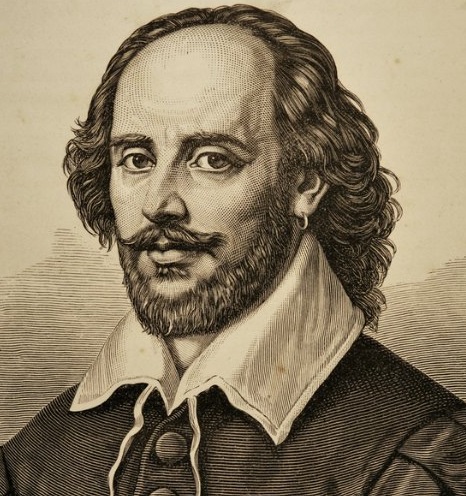
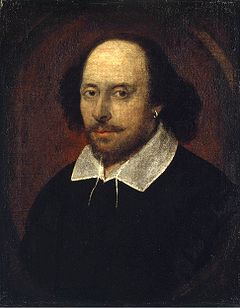
William Shakespeare (1564-1616). English poet and playwright – Shakespeare is widely considered to be the greatest writer in the English language. He wrote 38 plays and 154 sonnets.
Short bio of William Shakespeare
William Shakespeare was born in Stratford-upon-Avon on 23rd April 1564.
His father William was a successful local businessman, and his mother Mary was the daughter of a landowner. Relatively prosperous, it is likely the family paid for Williams education, although there is no evidence he attended university.
In 1582 William, aged only 18, married an older woman named Anne Hathaway. They had three children, Susanna, Hamnet and Juliet. Their only son Hamnet died aged just 11.
After his marriage, information about the life of Shakespeare is sketchy, but it seems he spent most of his time in London – writing and acting in his plays.
Due to some well-timed investments, Shakespeare was able to secure a firm financial background, leaving time for writing and acting. The best of these investments was buying some real estate near Stratford in 1605, which soon doubled in value.
It seemed Shakespeare didn’t mind being absent from his family – he only returned home during Lent when all the theatres were closed. It is thought that during the 1590s he wrote the majority of his sonnets. This was a time of prolific writing and his plays developed a good deal of interest and controversy. His early plays were mainly comedies (e.g. Much Ado about Nothing, A Midsummer’s Night Dream) and histories (e.g. Henry V)
By the early Seventeenth Century, Shakespeare had begun to write plays in the genre of tragedy. These plays, such as Hamlet, Othello and King Lear, often hinge on some fatal error or flaw in the lead character and provide fascinating insights into the darker aspects of human nature. These later plays are considered Shakespeare’s finest achievements.
Some academics, known as the “Oxfords,” claim that Shakespeare never actually wrote any plays. They contend Shakespeare was actually just a successful businessman, and for authorship suggest names such as Edward de Vere. Nevertheless, there is evidence of Shakespeare in theatres as he received a variety of criticism from people such as Ben Johnson and Robert Greene. When writing an introduction to Shakespeare’s First Folio of published plays in 1623, Johnson wrote of Shakespeare:
“not of an age, but for all time”
Shakespeare the Poet
William Shakespeare wrote 154 sonnets mostly in the 1590s. These short poems, deal with issues such as lost love. His sonnets have an enduring appeal due to his formidable skill with language and words.
“Let me not to the marriage of true minds Admit impediments. Love is not love Which alters when it alteration finds, Or bends with the remover to remove:”
– Sonnet CXVI
The Plays of Shakespeare
The plays of Shakespeare have been studied more than any other writing in the English language and have been translated into numerous languages. He was rare as a play-write for excelling in tragedies, comedies and histories. He deftly combined popular entertainment with an extraordinary poetic capacity for expression which is almost mantric in quality.
“This above all: to thine ownself be true, And it must follow, as the night the day, Thou canst not then be false to any man. Farewell: my blessing season this in thee!”
– Lord Polonius, Hamlet Act I, Scene 3
During his lifetime, Shakespeare was not without controversy, but he also received lavish praise for his plays which were very popular and commercially successful.
His plays have retained an enduring appeal throughout history and the world. Some of his most popular plays include:
Twelfth Night
Henry V
c
Macbeth
Hamlet
King Lear
Othello
“All the world’s a stage, and all the men and women merely players: they have their exits and their entrances; and one man in his time plays many parts…”
—As You Like It, Act II,
Death of Shakespeare
Shakespeare died in 1616; it is not clear how he died, and numerous suggestions have been put forward. John Ward, the local vicar of Holy Trinity Church in Stratford (where Shakespeare is buried), writes in a diary account that:
“Shakespeare, Drayton, and Ben Jonson had a merry meeting and it seems drank too hard, for Shakespeare died of a fever there contracted.”
In 1616, there was an outbreak of typhus (“The new fever”) which may have been the cause. The average life expectancy of someone born in London, England in the Sixteenth Century was about 35 years old, Shakespeare died age 52.
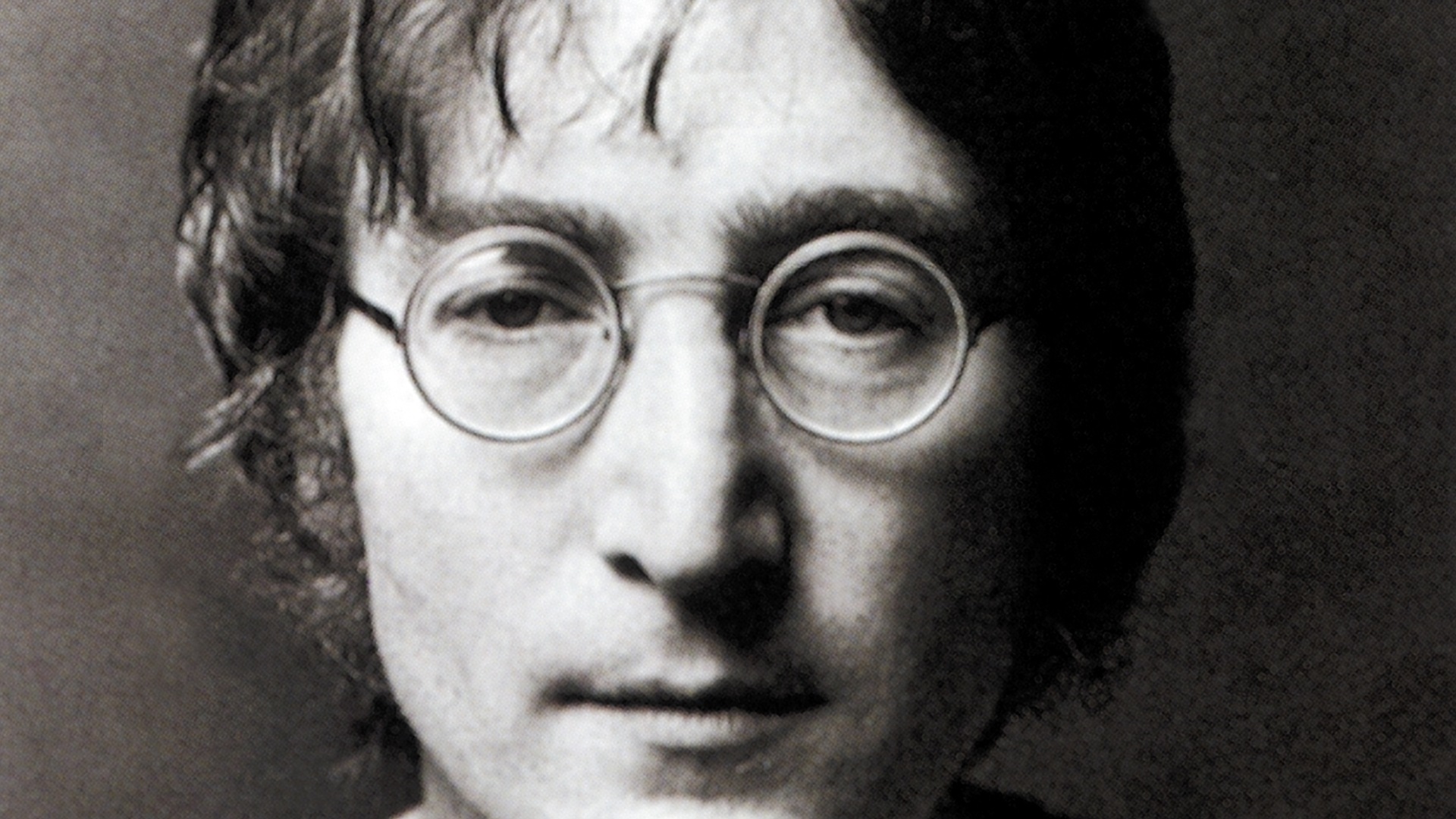
‘Gimme Some Truth’ appears on John Lennon’s 1971 album Imagine, and in a sense it serves as the aesthetic and ideological counterbalance of that album’s legendary title track.
‘Imagine’ evokes a utopian world in which our heightened consciousness would make everything that oppresses us wither away, ‘Gimme Some Truth’ looks our real troubled world square in the eye and demands answers right now. If one song floats like a feather on a piano melody as gentle as an evening breeze, the other rides a droning, distorted guitar line and a searing slide-guitar solo. If one vocal sounds as intimate as your good angel speaking to you from someplace inside your own mind, the other pins you against the wall, so impassioned that the singer can barely take the breaths he needs to spit out his lyrics.
Those are two of the many sides of John Lennon, two expressions of the many truths that he came to know. These days we live in a world that to value an unthinking consistency above all other virtues. If you hold an opinion that contradicts something that you said twenty years before, it’s not assumed that you’ve simply matured or reconsidered your earlier views for perfectly good reasons. No, you’re a waffler, a hypocrite, a flip-flopper. People are not encouraged to ‘contain multitudes’, in Ralph Waldo Emerson’s immortal phrase. They are encouraged to be as small and one-dimensional as possible if they want to avoid controversy.
Lennon did not see himself or his world in those terms. He thought of his songs as snapshots of what he was thinking and feeling at the moment of composition. He believed that the one quality his calling as an artist demanded of him was complete emotional and intellectual honesty. And from his earliest years, he had no interest in disguising what he had to say to bring it into conformity with what anyone else thought his ideas should be, or even with points of view he may have felt at one time himself. If he was true to the emotion that had given birth to the song, that was enough.
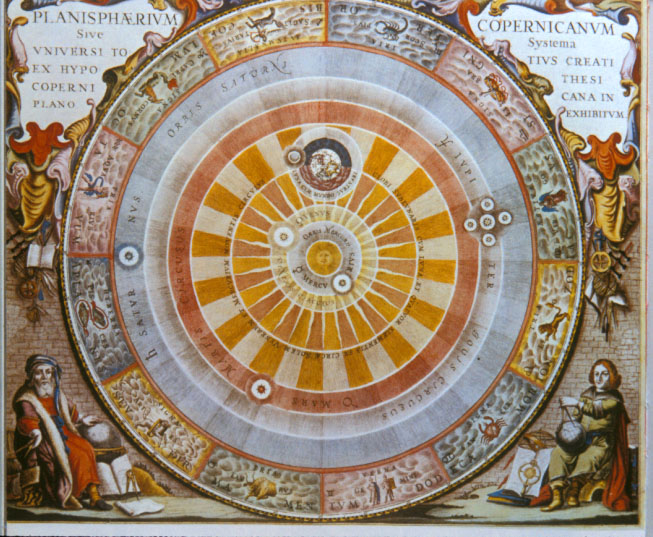
In the whole world prior to Galileo’s conflict with the Church, the majority of educated people subscribed either to the Aristotelian geocentric view that the earth was the center of the universe and that all heavenly bodies revolved around the Earth, or the Tychonic system that blended geocentrism with heliocentrism.[
Opposition to heliocentrism and Galileo’s writings combined scientific and religious objections. Scientific opposition came from Tycho Brahe and others and arose from the fact that, if heliocentrism were true, an annual stellar parallax should be observed, though none was. Copernicus and Aristarchus had correctly postulated that parallax was negligible because the stars were so distant. However, Brahe had countered that, since stars appeared to have measurable angular size, if the stars were that distant and their apparent size was due to their physical size, they would be far larger than the Sun. (In fact, it is not possible to observe the physical size of distant stars without modern telescopes). In Brahe’s system the stars were a little more distant than Saturn, and the Sun and stars were comparable in size.[
Religious opposition to heliocentrism arose from Biblical references such as Psalm93:1, 96:10, and 1 Chronicles16:30 which include text stating that “the world is firmly established, it cannot be moved”. In the same manner, Psalm 104:5 says, “the Lord set the earth on its foundations; it can never be moved”. Further, Ecclesiastes1:5 states that “the sun rises and sets and returns to its place”.[
Galileo defended heliocentrism based on his astronomical observations of 1609 (Sidereus Nuncius 1610). In December 1613, the Grand Duchess Christina of Florence confronted one of Galileo’s friends and followers, Benedetto Castelli, with biblical objections to the motion of the earth. According to Maurice Finocchiaro, this was done in a friendly and gracious manner, out of curiosity. Prompted by this incident, Galileo wrote a letter to Castelli in which he argued that heliocentrism was actually not contrary to biblical texts, and that the bible was an authority on faith and morals, not on science. This letter was not published, but circulated widely.[
By 1615, Galileo’s writings on heliocentrism had been submitted to the Roman Inquisition by Father Niccolò Lorini, who claimed that Galileo and his followers were attempting to reinterpret the Bible, which was seen as a violation of the Council of Trent and looked dangerously like Protestantism.[73] Lorini specifically cited Galileo’s letter to Castelli. Galileo went to Rome to defend himself and his Copernican and biblical ideas. At the start of 1616, Monsignor Francesco Ingoli initiated a debate with Galileo, sending him an essay disputing the Copernican system. Galileo later stated that he believed this essay to have been instrumental in the action against Copernicanism that followed. According to Maurice Finocchiaro, Ingoli had probably been commissioned by the Inquisition to write an expert opinion on the controversy, and the essay provided the “chief direct basis” for the Inquisition’s actions. The essay focused on eighteen physical and mathematical arguments against heliocentrism. It borrowed primarily from the arguments of Tycho Brahe, and it notedly mentioned Brahe’s argument that heliocentrism required the stars to be much larger than the Sun. Ingoli wrote that the great distance to the stars in the heliocentric theory “clearly proves … the fixed stars to be of such size, as they may surpass or equal the size of the orbit circle of the Earth itself.” The essay also included four theological arguments, but Ingoli suggested Galileo focus on the physical and mathematical arguments, and he did not mention Galileo’s biblical ideas.[ In February 1616, an Inquisitorial commission declared heliocentrism to be “foolish and absurd in philosophy, and formally heretical since it explicitly contradicts in many places the sense of Holy Scripture”. The Inquisition found that the idea of the Earth’s movement “receives the same judgement in philosophy and … in regard to theological truth it is at least erroneous in faith”. (The original document from the Inquisitorial commission was made widely available in 2014.[80])
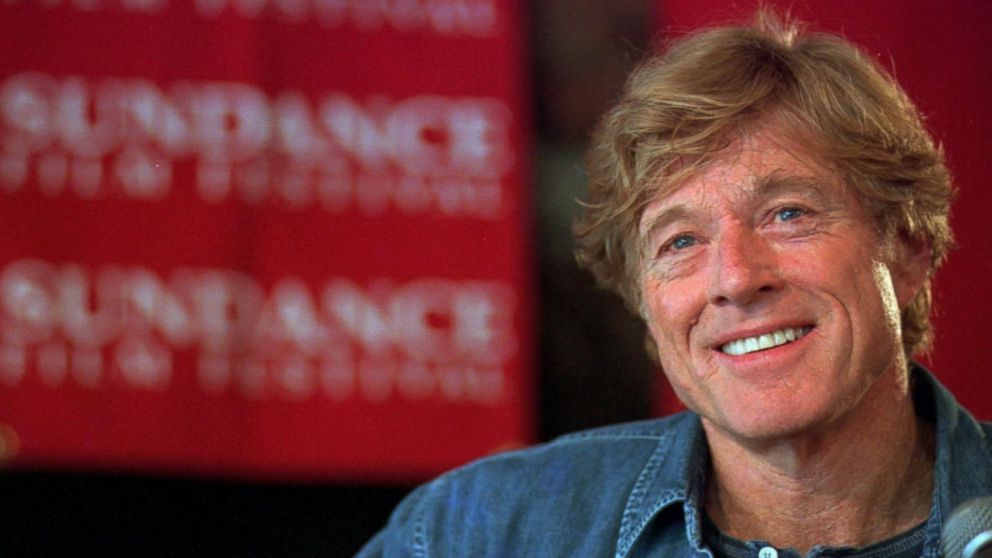
Co-founded in 2005 by Robert Redford and his son and board chair, James Redford, The Redford Center harnesses the power of film, video and new media to engage people through inspiring stories that galvanize environmental action.
Drawing on the family’s multi-generational expertise in filmmaking and activism, we produce, fund and fiscally sponsor impact-driven productions that showcase stories of individuals taking action to protect and restore the planet.
Leveraging our network of issue experts and a stable of talented directors and producers, The Redford Center carefully vets each project we take on through one of our programs.
Redford Center Original Productions produces original impact-driven documentaries that showcase stories of people taking action to protect and restore the planet for current and future generations. Each carefully vetted project starts with a thorough analysis of the issues and is produced in-house by a nimble team of adept filmmakers. All feature length Redford Center original productions are released with an accompanying long-term community impact campaign designed to engage people with inspiring stories that galvanize environmental action.
Redford Center Grants provides early-stage funding to independent media makers telling hopeful stories that drive awareness, education and tangible action on a variety of environmental topics.
Fiscal Sponsorships extend our 501(c)(3) tax-exempt status to independent filmmakers so they can solicit tax-deductible donations from individuals, foundations and other grantors.
Throughout our process, we collaborate with artists, activists, issue experts, policymakers, educators, scientists, business leaders and philanthropists. We invite issue outliers into the conversation as well so they can understand how they too can be part of the solution.
Because we believe a greater impact occurs when environmental champions join forces, The Redford Center works with change-making organizations to lead community engagement campaigns that spark conversation and galvanize environmental action.



 Sketches of Spain (And Other Things)